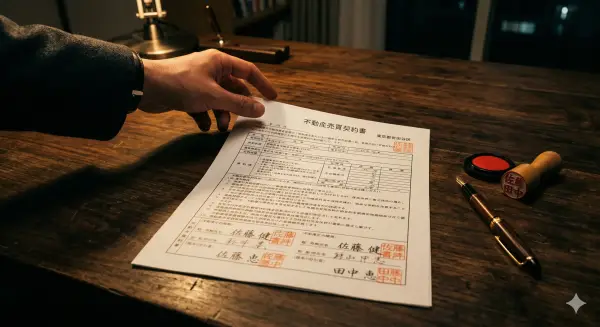
P2P Crypto Scams Disguised as Property Purchases — The Risk Behind SNS Referrals
What You Will Learn
Q. What is a cryptocurrency scam disguised as a real estate purchase?
Q. What are the warning signs that a property inquiry may be fraudulent?
Q. How should a brokerage respond when fraud is suspected?
The referral came from one of our real estate partners.
This partner was a young entrepreneur who had founded his first company as a teenager and was already running three businesses while still in school. He had been contacted via social media by someone claiming to want to buy an apartment, and he passed the inquiry along to us.
We had no doubt the referrer himself was trustworthy. But he was still early in his career. It seemed he had introduced the prospect without fully vetting their background. And that is where the circus began.
Starting with OpenChat
We began the conversation on LINE OpenChat. OpenChat lets people communicate without revealing their personal LINE IDs, which protects the other party’s privacy. Identity verification comes later if the deal progresses — at this early stage, OpenChat is the better fit. There is also a practical reason: LINE limits each user to 1,000 group memberships, and creating a new group for every inquiry would eat through that cap quickly. OpenChat has no such constraint.
But the prospect immediately pushed to create a regular LINE group. At the time, it just seemed odd — why switch when OpenChat was already working? In hindsight, it was obvious. OpenChat does not expose individual LINE accounts. If the goal is to connect with people personally, an anonymous chat room is useless.
The requirements looked perfectly normal
The prospect’s stated criteria were as follows:
- Property type: apartment or detached house
- Purpose: personal residence
- Floor area: 60 sqm or more
- Parking: 1 space (SUV-compatible)
- Budget: approximately ¥100–200 million
- Within a 10-minute walk from the nearest station
A foreign national looking for a home in central Tokyo — nothing unusual. The requirements were specific, the budget realistic. We compiled a shortlist of apartments and sent it over.
First red flag — an owner-change property
The one the prospect latched onto was an owner-change property — a unit sold with an existing tenant in place.
The moment I sent it, I realized I had accidentally included an investment property in the list. But then the prospect asked: “Is someone living there?”
It was written right there in the documents. They clearly could not read Japanese.
That alone was not suspicious — they were foreign, after all. But when I replied, “There is a tenant currently in residence,” the response was: “Please send me a quote.”
They had said they wanted a personal residence. How exactly do you move in when someone else is already living there? A small warning light switched on.
The real agenda: USDT
Almost immediately afterward, a message arrived on a private LINE chat:
I’ve been thinking about investing in USDT lately, but I’m a bit short on funds right now… If you happen to know anyone who holds USDT, could you introduce me? I’m planning to exchange it for Japanese yen in cash, and I can pay a commission. If things go well, I’d love to build a long-term relationship — I’m thinking of offering 1% of each exchange amount as a thank-you.
This message was sent not only to me, but also to the young partner who had made the referral, and to our sales representative.
USDT (Tether) is a stablecoin pegged to the US dollar. Peer-to-peer exchanges of USDT for cash — bypassing licensed exchanges — are a well-known vector for money laundering. The moment they asked a real estate agent to “introduce someone who holds it,” their purpose was obvious.
The property search was bait to build trust. The real target was access to the high-net-worth network that real estate agents maintain.
After we declined, it was renovation contractors
We politely turned down the USDT request. The next message: “After I buy the property, I’d like to do some renovations — could you introduce me to a contractor?”
Renovations on an owner-change property? With a tenant living in it, unauthorized renovations are not possible. And no property had even been chosen yet.
In the end, it did not matter what the pretext was — as long as it generated an introduction. Real estate, USDT, renovation contractors — the excuses kept changing, but the play was always the same: infiltrate the network.
At this point, we concluded it was a scam.
No one got hurt
In the end, the damage was zero.
The young partner who made the referral was probably the most shaken. But we did not consider it a problem — it was a good lesson for him.
Our sales representative said, “It’s been a while since one of these came along.” Good training. And for me, it made for one more article.
Everyone gained experience, and nobody lost money. Imagining what could have happened if we had not caught on is unsettling — but this time, we spotted the inconsistencies early.
Three points for spotting the scam
Based on this experience, here is what real estate professionals should watch for:
First, never ignore contradictions between stated purpose and actual behavior. Claiming to want a personal residence but selecting a tenant-occupied investment property. Requesting a quote without being able to read the documents. Small contradictions, individually, but together they become certainty.
Second, treat requests for non-real-estate financial transactions as a red flag. We were discussing properties, and suddenly the conversation shifted to finding a USDT cash-exchange partner. This was an approach designed to exploit the personal networks of real estate agents. When a request has nothing to do with your core business, question the other party’s true motive.
Third, do not trust a prospect simply because they came through a referral. The referrer in this case was genuinely trustworthy. But that does not mean the referrer has thoroughly vetted the person they are introducing. Referrals that originate from social media encounters are especially prone to gaps in identity verification.
Identity verification is an agent’s lifeline
Identity verification in real estate transactions is mandated by Japan’s Act on Prevention of Transfer of Criminal Proceeds (Hanzai Shūeki Iten Bōshi Hō). Licensed real estate brokers are required to verify the identity of clients at the time of a transaction.
But beyond the law, identity verification is the lifeline that protects an agent’s reputation. Bringing an unvetted party into a transaction could, in the worst case, make your firm an unwitting accomplice to money laundering.
This time, we caught it early enough that it became a story to laugh about. But if the scammer had been a little more sophisticated, had spent a little more time building trust — I cannot say with certainty we would have seen through it as easily.
Real estate deals involve enormous sums of money, and fraud is never far behind. From low-level SNS scams like this one to jimenshi (地面師) — imposters who forge identities to sell land they do not own — these people are very real.
That is precisely why you never dismiss a small red flag. In the field, it is the only way to protect yourself.
This article is based on a real experience. Some details have been altered to protect privacy. It is not intended as individual investment advice.
Japan Real Estate Inquiries
Property introductions, valuations, transaction issues, tax matters — feel free to reach out about anything related to Japan real estate.
Contact Us