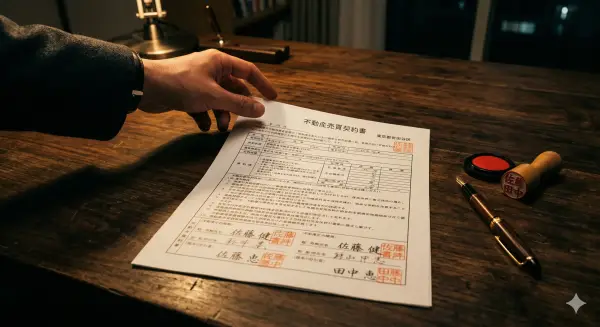
Breaking the Exclusive Listing — When Sellers Run Parallel Deals
What You Will Learn
Q. What happens if a seller closes a sale through another broker during an exclusive listing period in Japan?
Q. For high-value properties in Japan, is exclusive or non-exclusive listing more common?
It’s a familiar tell. A property is under exclusive listing — and then another broker calls asking, “Do you still have that property?” Or a different brokerage’s name slips out during a meeting with the seller. In both cases, the signal is the same: the seller is running something on the side.
An exclusive listing agreement is a mutual promise. The seller pledges not to engage other brokerages; the listing firm pledges to put real effort into selling the property. When the promise breaks, the contract turns into a piece of paper.
In Japan’s ultra-luxury segment, the break is real. The reason is straightforward — the commissions are in a different order of magnitude.
The Three Types of Listing Agreements
Article 34-2 of Japan’s Real Estate Brokerage Act (宅地建物取引業法) recognizes three categories of listing agreement between a seller and a brokerage firm.
Non-exclusive (一般媒介). The seller can engage multiple firms at once. This offers flexibility, but each firm has less incentive to invest in marketing, knowing a rival might close first. There is no obligation to register the property on REINS (Japan’s MLS) or to report activity.
Exclusive (専任媒介). Only one brokerage is engaged, though the seller retains the right to find a buyer independently (self-discovery transaction, 自己発見取引). The firm must register on REINS within 7 business days and report activity at least every two weeks.
Exclusive-sole (専属専任媒介). Only one firm, and self-discovery transactions are not permitted. REINS registration is required within 5 business days, and reporting must occur at least weekly — stricter than the regular exclusive.
Maximum term for any listing agreement: 3 months. Automatic-renewal clauses are generally considered invalid; the seller’s affirmative consent is required for renewal.
Why does a seller accept the constraint of exclusivity? It aligns the firm’s incentives. Under non-exclusive listings, another firm might close the deal first, rendering advertising spend worthless. Firms therefore hold back. Exclusivity guarantees that the firm investing in the sale will be the one to close it, so they commit advertising budget and personnel. The alignment between seller and broker is the entire point of an exclusive listing.
”I Can Sell It for More”
Into this setup walks another broker. The playbook is always the same.
“I can sell it higher.” “I already have a buyer ready.” “I’ll discount the commission.” Lines designed to press exactly the wrong buttons for the seller.
By the third month without a sale, the seller is anxious. The gap between the appraised price and the market’s actual response breeds distrust in the listing firm. When someone whispers “I can sell it higher,” the appeal is not hard to understand.
At the ultra-luxury tier, the temptation reaches another level. Japan’s legal cap on brokerage commissions is “3% of the sale price + ¥60,000 + consumption tax.” For reference:
- ¥100 million property — approx. ¥3.36M (approx. $22K)
- ¥500 million property — approx. ¥16.5M (approx. $110K)
- ¥1 billion property — approx. ¥33M (approx. $220K)
- ¥2 billion property — approx. ¥66M (approx. $440K)
Close as dual-agent and those figures double. For that kind of money, some brokers will happily induce the seller to pay a penalty to escape an existing exclusive. The same commission math drives listing-agent bypassing and contract hijacking — all three practices spring from the same structural incentive.
The View from the ¥1 Billion Tier
Once a transaction crosses the ¥1 billion threshold (approx. $6.7M), the landscape changes.
A seller will hint that they’d consider “exclusive-sole, if you like.” But as conversations progress, it becomes clear they’re making the same pitch to other firms. It’s not exclusivity — it’s dangling the word as a tool to play firms against each other.
Sellers at this level don’t have a firm grasp of their property’s price. Comparable sales barely exist at the tens-of-millions-of-dollars range, and the final figure depends entirely on “who can produce the right buyer.” That’s why sellers want as many firms running in parallel as possible. A hint of exclusivity makes each firm commit marketing resources — a coldly rational calculation.
Information handling gets delicate too. Once, materials for a listing were shared with a licensed real estate dealer, and some time later the seller called with a complaint: “Some stranger just contacted me. What’s going on?” Someone — either the firm that received the materials, or another step down the chain — had gone directly to the seller. Professional information-sharing rests on trust; when a bad actor enters the chain, the seller’s relationship with their own brokerage gets damaged along the way.
At the ultra-luxury tier, the integrity of every firm in the information chain determines the fate of the entire transaction. From the seller’s perspective, not knowing how many parties their property has reached creates real anxiety about being quietly shopped around. That’s why, in this price band, it’s common to skip exclusivity entirely and work with a small group of trusted firms on a non-exclusive basis.
A seller breaking exclusivity and a broker bypassing a listing agent are two sides of the same coin. Sellers struggle to commit to exclusivity because they know information leaks; brokers hoard properties because they know information shared gets poached.
Legal Consequences of Breaking an Exclusive
An exclusive listing is a contract for exclusivity. Breaking it carries penalties.
Seller-side penalty. The Standard Listing Agreement Terms (標準媒介契約約款), published by Japan’s Ministry of Land, Infrastructure, Transport and Tourism (MLIT), provide that if a sale closes through another broker during the exclusive period, the listing firm can claim a penalty equal to the “agreed commission amount” (Article 12 of the Standard Exclusive Listing Agreement). On a ¥1 billion property, that works out to roughly ¥33M (approx. $220K). Because the amount is structured as liquidated damages, no proof of actual loss is required.
Expense recovery. Separate from the penalty, the listing firm may recover out-of-pocket costs such as advertising and due diligence. The standard terms generally don’t allow stacking penalty and expense claims, but wording in specific contracts varies — there is room for both in some cases.
Liability of the poaching broker. A broker who approaches a seller and induces them to break an exclusive faces civil liability as well. The displaced listing firm can bring a claim in tort. In Yokohama District Court, February 1, 2006, the court characterized this type of poaching as “seriously contrary to the principle of good faith” (信義則違反) and found it constituted a tort.
Deemed commission. In Supreme Court, October 22, 1970, the court applied Article 130 of the Civil Code (obstruction of condition fulfillment) by analogy and recognized the commission claim of a broker who had been unfairly excluded from a transaction. In Tokyo District Court, July 3, 2013, the court fixed the deemed commission at 80% of 3% of the sale price. Depending on the facts, deemed commissions have ranged from as little as one-sixth to the full amount — but “excluded brokers get nothing” is not the outcome.
No written contract? Doesn’t matter. Tokyo High Court, December 24, 1986 recognized commission claims proportional to a broker’s contribution even without a formal written listing agreement. The “I didn’t sign anything, so I’m safe” escape is narrower than most sellers assume.
Penalty, expense recovery, tort liability, and deemed commission — breaking an exclusive imposes costs on both the seller and the poaching broker.
The Hoarding-Betrayal Feedback Loop
Even with these legal risks clearly established, exclusive-listing betrayals keep happening. Part of the reason sits with the seller’s side: a sense that “breaking it was justified.” That sense comes from hoarding (囲い込み).
Hoarding is the practice of a listing firm sitting on an exclusive and refusing to cooperate with other firms in order to capture both sides of the commission (dual agency). From the seller’s perspective, they keep hearing “it’s just not selling” while, unbeknownst to them, the firm is turning away inquiries from other agents.
Dual-agency rates at Japan’s major brokerage firms have been reported for years, most prominently by Diamond Real Estate Research: roughly 50–57% at Sumitomo Real Estate Sales, around 40–43% at Mitsui’s Rehouse, and about 37% at Tokyu Livable (industry surveys suggest the gap is narrowing in recent years, but a material spread between firms remains). The interpretation of these figures is contested, but “my property may be hoarded” is a suspicion that accumulates in sellers’ minds on the ground.
That accumulated distrust becomes the rationale for breaking exclusivity. A seller who feels “my firm isn’t really working on this” finds it easier to tell themselves “there’s nothing wrong with hearing out another broker.” Hoarding fuels the justification for betrayal.
That said, amendments to the Real Estate Brokerage Act enforcement regulations that took effect in January 2025 made it explicit that falsifying REINS transaction status is subject to administrative sanction. REINS registration certificates now carry a QR code that lets sellers verify their property’s transaction status in real time. Institutional deterrents against hoarding are slowly tightening.
Still, hoarding conducted verbally (“we’re currently in negotiation”) over the phone remains difficult to prove. Even with better systems, on-the-ground distrust does not disappear overnight.
Why High-End Sellers Choose Non-Exclusive
Surveys of Japanese listing agreements show roughly the following distribution (data from around 2020, per Tokyo Theatres Mansion Sales Research):
- Exclusive (専任) 31.5% (largest share)
- Non-exclusive (一般) 26.6%
- Exclusive-sole (専属専任) 11.0%
Across the market, exclusive listings are most common. But at the ultra-luxury tier, the pattern inverts. It is not unusual for sellers of ¥1 billion-plus properties to intentionally engage multiple firms under non-exclusive terms.
The reasoning is direct. Properties with intrinsic appeal get serious attention from firms even without exclusivity. At the ultra-luxury level, buyers are scarce, so every firm wants to place its best-matching buyer. Making firms compete, the seller reasons, surfaces better terms.
Survey data suggests sellers who used non-exclusive listings reported “satisfied with the sale price” at 29.8%, versus 25.8% for exclusive listings (LIFULL HOME’S Valuation survey of sellers). Sample-size caveats apply, and results depend heavily on property characteristics — but the data suggests “exclusive listings fetch higher prices” is not self-evident.
From a brokerage firm’s perspective, non-exclusive listings come with competition, which makes it harder to justify advertising spend. That’s the whole reason firms push for exclusivity. But from the seller’s perspective, starting with non-exclusive means never having to feel “I gave them exclusivity and they’re not doing anything about it.”
Which is right? If you can identify one firm with the strongest sales capability, exclusive works. If you want competition to surface the best buyer, non-exclusive works. The answer depends on the property and the seller’s situation. But one rule applies either way: if you sign an exclusive, don’t engage other firms. That is the baseline.
Exclusivity as Trust
The throughline of this article is that breaking an exclusive does not pay — legally or economically.
Penalties run to the full commission amount, and poaching brokers wear the “good-faith violator” label in the industry. Japanese courts have taken a broad view of commission claims from displaced brokers, and evasions like “there was no written contract” or “I tore up the paper” do not hold up.
The deeper problem is that breaking an exclusive progressively weakens the seller’s own position. Anxiety from “three months and no sale” leads them to bite on sweet talk from another broker; they take on a penalty; and the industry gets tagged with “this is a seller who breaks contracts.” The same structural trap that snares sellers whose signed deals get hijacked plays out at the exclusive-listing stage.
An exclusive listing is the trust the seller extends to the brokerage firm. That trust is what lets the firm commit advertising budget, devote time to finding a buyer, and work the relationships needed to close. A firm that operates on the assumption its trust will be betrayed runs a weaker, risk-hedged sales process. In the end, the loss falls on the seller.
When another broker whispers “I can sell it for more,” remember: will that broker front the penalty for you? Ask the question, and the answer is clear in an instant.
Articles on this site are based on hands-on industry experience and are not intended as individual investment advice.
Japan Real Estate Inquiries
Property introductions, valuations, transaction issues, tax matters — feel free to reach out about anything related to Japan real estate.
Contact Us