¥1.2 Billion for Residential Land in Shibuya — Are Tokyo's Premium Neighborhoods Actually Livable?
What You Will Learn
Q. Are Tokyo's upscale residential areas inconvenient for daily life?
Q. With the same budget, which is better: land or a tower apartment?
Q. Why do supermarkets disappear from high-priced areas?
A residential lot in Shibuya Ward: ¥1.2 billion. Looking at the off-market listing that had just arrived, I let out a sigh.
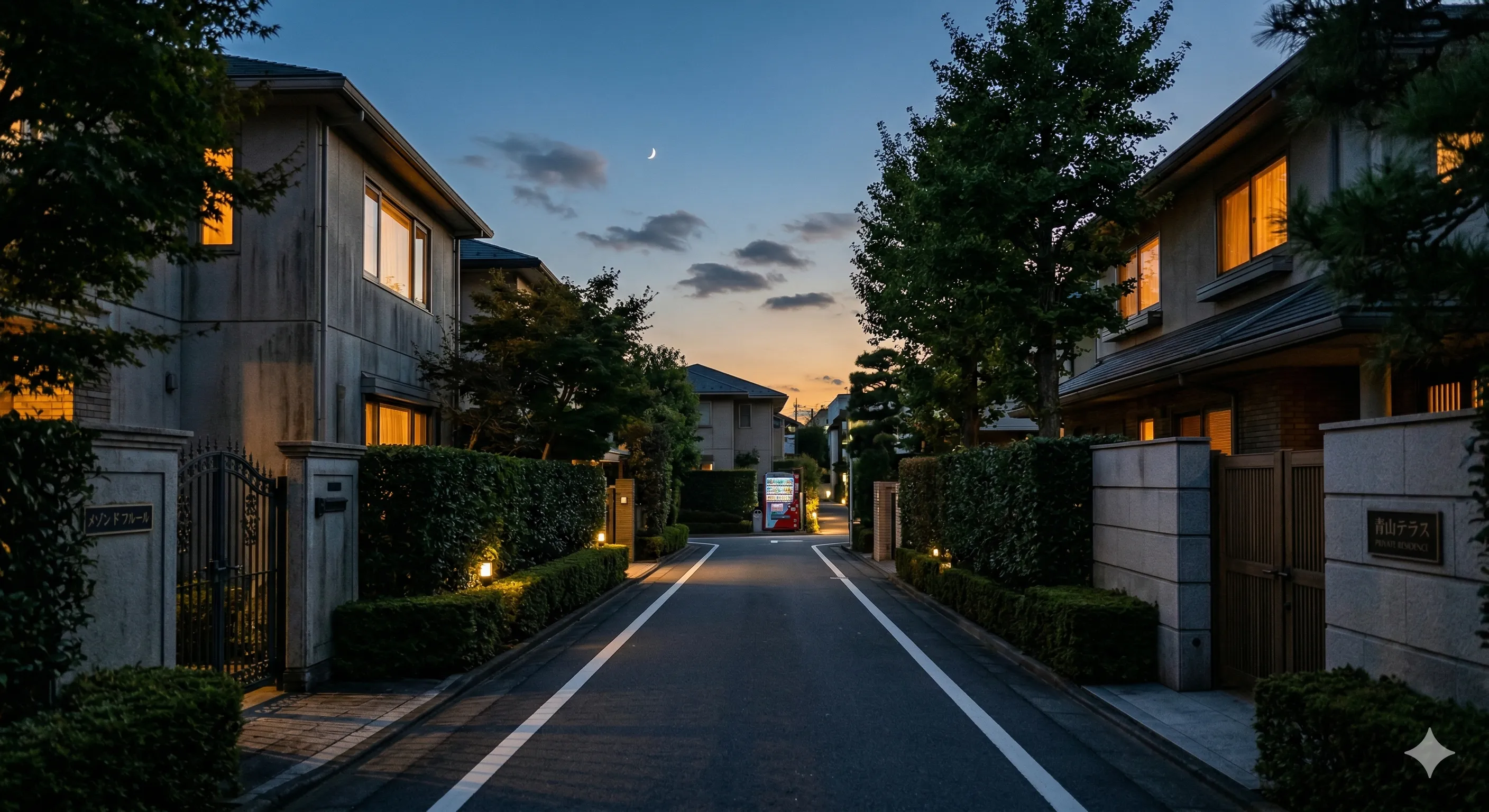
It was a good deal lower than the ¥1.95 billion property I brokered last year, but this too sat in a quiet residential pocket of Shibuya. Houses lined both sides of the street. At just over 100 tsubo (approx. 330 m² / 3,550 ft²), the lot was large enough that — depending on the plan — it could accommodate more than just a detached house. A small building might even be feasible.
Still, real estate prices in central Tokyo are staggering. I’ve handled land at similar price points in Minato Ward, just next door to Shibuya. You might expect nothing but mansions on land this expensive, but walk around and you’ll find modest houses that look like they belong in a Doraemon episode — Nobita’s house, basically.
Is There a “Market Price” for Off-Market Properties?
Looking at actual transaction prices, you sometimes think: “That location went for this much, and yet this place costs that much?”
Properties that never appear on REINS (Japan’s MLS equivalent) essentially have no market price — that’s an overstatement, but not by much. As I touched on in the REINS article, ultra-high-end properties have almost no comparables. Price is determined not by appraisal but by whether someone willing to pay that amount can be found.
Land at ¥1.2 Billion vs. a Tower Apartment at ¥2 Billion
To get roughly the same floor area in a tower apartment as this 100-tsubo-plus lot would cost around ¥2 billion.
Comparing raw land to a tower apartment is admittedly crude, but the better choice depends on purpose.
For views and a functional living environment, a tower apartment wins hands down. High-floor panoramas are something a detached house simply cannot offer. Concierge services, gym, guest rooms, 24-hour security — the full suite of shared amenities comes standard.
For private space, a detached house may have the edge. No neighbors above, below, or on either side. A garden is possible. And above all, no waiting for an elevator. You step out the front door and you’re outside. For anyone who goes out frequently, that ease of access is hard to dismiss.
Security, however, is one area where a detached house inevitably falls short of a tower apartment.
When Land Prices Rise, Shops Disappear
This is the real point.
When land prices climb too high, rents follow, and businesses that operate on thin margins can no longer survive. Shops that sell affordable, everyday goods are the first to go. The people left inconvenienced are the ones who actually live there.
The Peacock Store in Omotesando — 54 Years, Gone
Even around Omotesando, where our office is located, a quick errand means a convenience store and not much else.
The most telling example is the Peacock Store Aoyama branch. It opened in 1964 as Daimaru Peacock’s first store in the Kanto region and served the tables of Minami-Aoyama for 54 years. In February 2019, it closed due to the aging of the building it occupied.
After the closure, “shopping refugees” in the area became a topic in the Minato Ward assembly. The ward went so far as to request that real estate developers recruit a supermarket to the site.
“Shopping refugees in Omotesando? That’s a stretch,” you might think. True, Seijo Ishii and Kinokuniya International are still there. But shops where you could buy fresh fish and meat at everyday prices were few. The high-end grocers stayed; the ordinary supermarket vanished. That is what happens in central Tokyo.
Natural House, Then Three More Peacock Stores
The Peacock Store in Aoyama was not an isolated case. Natural House Aoyama, which had operated near Omotesando for over 30 years, closed in March 2024.
Then in February 2026, three Peacock Store locations in Minato Ward shut down in quick succession: the Ebisu branch (opened 1975), the Mita-Isarago branch, and the Takanawa Gyoranzaka branch. Both the Ebisu and Takanawa stores closed because their buildings were being demolished and rebuilt.
Buildings from the 1960s and ’70s are all reaching the end of their lifespan at the same time, and supermarket tenants are forced out. After reconstruction, rents surge, and low-margin supermarkets cannot come back. Only high-revenue tenants can afford the new space.
This cycle repeats, and everyday shopping options gradually vanish from central Tokyo.
Lunch Refugees and the Standing Soba Queue
It’s not just supermarkets.
Around Omotesando, “lunch refugees” is a recurring topic of conversation. For office workers, there are simply too few places to get an affordable midday meal. The standing soba shop on Aoyama-dori always has a line out the door.
Rents are too high for budget restaurants to last. In 2024, restaurant bankruptcies in Japan hit a record 894 cases — squeezed by rising labor costs, ingredient prices, and rent. The more upscale the area, the worse this gets.
What Does “Livable” Actually Mean?
According to Japan’s Ministry of Agriculture, Forestry and Fisheries, the number of people with poor access to grocery shopping has surged by 89.2% in the Tokyo metropolitan area. Shopping refugees are not just a rural problem.
Premium neighborhoods and central-Tokyo prestige look attractive from the outside, but behind the facade, everyday infrastructure keeps thinning. The address gains status, land prices rise — yet the shops people need for daily life keep disappearing.
What makes a place livable is different for everyone. Once you’ve lived in a suburb with wide roads and almost no traffic, the narrow streets and relentless congestion of central Tokyo feel genuinely inconvenient. In the city, you walk everywhere. You could call it healthy — but if there’s nothing at the end of the walk, it’s not a healthy stroll. It’s just a wasted trip.
I look at this ¥1.2 billion lot and wonder: how would the person who lives here do their grocery shopping every day?
The articles on this site are based on professional experience in the field. They are not intended as individual investment advice.
Japan Real Estate Inquiries
Property introductions, valuations, transaction issues, tax matters — feel free to reach out about anything related to Japan real estate.
Contact Us