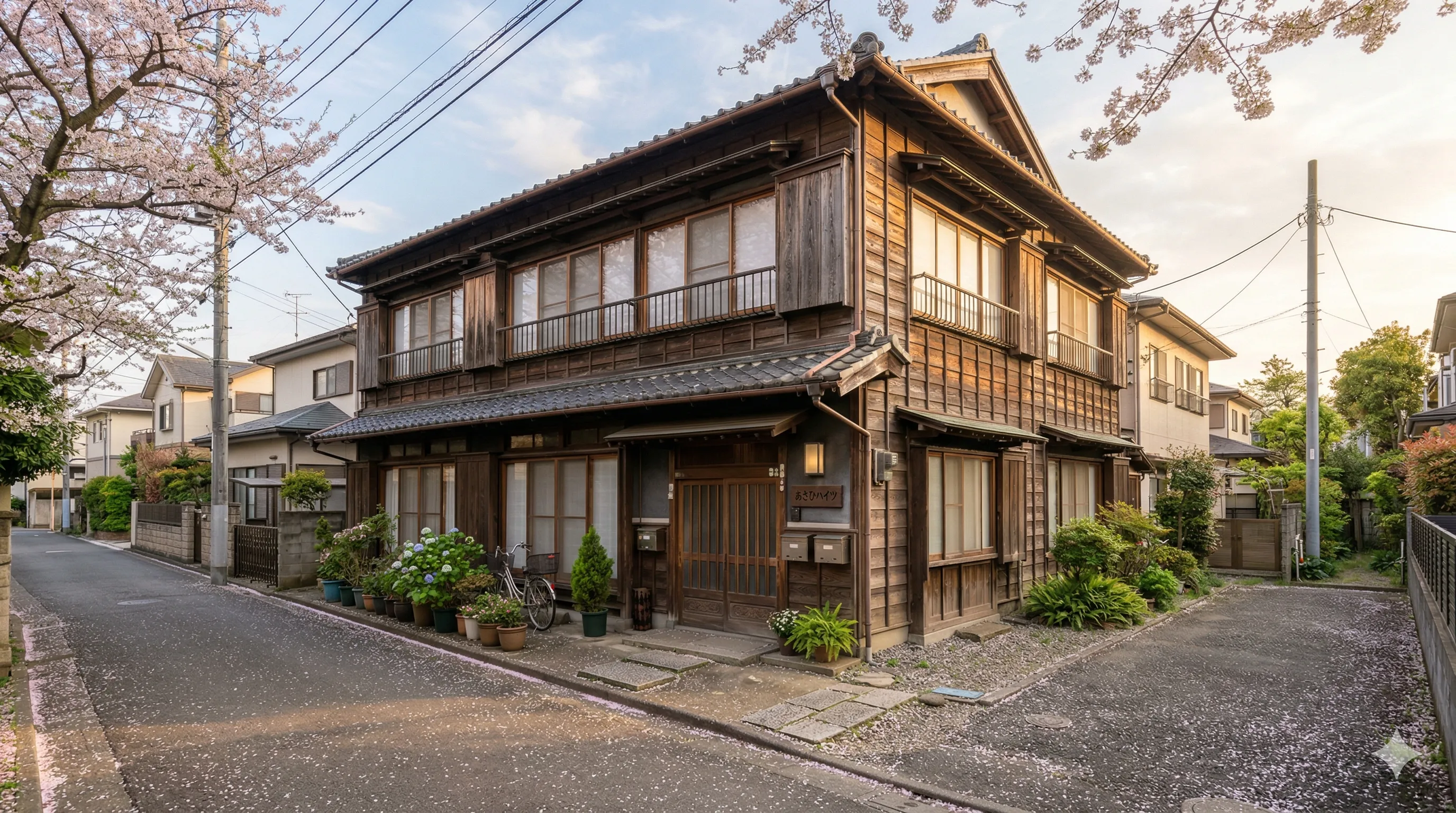
4-Year Depreciation on Used Wooden Buildings — Japan's Most Aggressive Legal Tax Tool
What You Will Learn
Q. Why can a wooden building be depreciated in just 4 years?
Q. What kind of properties qualify for 4-year depreciation?
Q. How much tax can a high-income investor actually save?
Q. What are the risks of 4-year depreciation properties?
Status as of April 2026: In force for individual and corporate taxpayers. Codified in Income Tax Act Enforcement Order Article 129 (所得税法施行令第129条) and clarified in NTA Tax Answer No. 5404 (Japanese). The parallel overseas-property 4-year scheme was closed for individuals in the 2020 tax reform under Act on Special Measures Concerning Taxation Article 41-4-3 (NTA guidance (Japanese)), effective for tax years from 2021 — a reminder that “in force” is always point-in-time. Last verified: 2026-04-18.
Every tax system has a most powerful tool. In Japan, for real estate investors, it is this: a used wooden building, 22 years old or older, fully depreciable in four years.
It is not hidden. It is not a loophole. It is the straightforward application of Japan’s depreciation formula for assets that have exceeded their statutory useful life — codified in Income Tax Act Enforcement Order Article 129 (所得税法施行令第129条). And yet it remains one of the least understood mechanisms among foreign investors — particularly those from jurisdictions like Hong Kong, where depreciation as a tax concept barely exists, or those from the U.S., where the standard residential useful life is 27.5 years (MACRS GDS) and no comparable fast-track exists for aged used property.
The Formula
Japan assigns a statutory useful life to every building based on its construction type:
| Structure | Statutory Useful Life |
|---|---|
| Reinforced Concrete (RC) | 47 years |
| Steel-frame (S) | 34 years |
| Wood (木造) | 22 years |
For used properties, the remaining depreciation period is recalculated:
- If within statutory life: (Remaining life) + (Original life × 20%)
- If statutory life exceeded: Original life × 20%
A wooden building aged 22 years or older has exceeded its 22-year statutory life. The depreciation period is therefore:
22 years × 20% = 4.4 years → 4 years (fractions under 1 year are dropped)
The entire depreciable value of the building — not the land, just the building — is written off over four years. One quarter per year.
Why This Matters for High-Income Investors
The power of this mechanism lies in the asymmetry between the tax rate at which the deduction is claimed and the tax rate at which the gain is eventually realized.
During the depreciation phase (Years 1–4): Depreciation is deducted from the investor’s ordinary income. For a Japanese tax resident in the top bracket, the marginal rate is approximately 50–55% (income tax + resident tax). Every ¥10 million of depreciation can save up to ¥5 million in tax, depending on the investor’s income composition and ownership structure.
At exit (Year 6+): When the property is sold, the accumulated depreciation is “recaptured” — the sale price minus the reduced book value is taxed as capital gains. If the property has been held for more than five years (measured from January 1 of the sale year), the long-term capital gains rate of 20.315% applies. (These rates apply to individual ownership of Japanese real estate; the exact treatment for non-resident investors may differ in filing and withholding procedures, so professional advice is recommended.)
The gap between the higher marginal rate on ordinary income and the lower capital gains rate is the benefit. The depreciation accelerates expense recognition to years when the tax rate is high, while the gain is realized later at a lower rate — a structural advantage built into the tax code, not merely a deferral.
This rate-arbitrage structure differs sharply from the U.S. model. Under IRC §1250, depreciation recapture on real property is taxed at a maximum of 25% — lower than ordinary rates, but still higher than the long-term capital gains rate. In Japan, once five years of ownership are cleared, the recaptured amount is taxed at the same 20.315% long-term rate as the rest of the gain. The asymmetry is sharper. For a top-bracket earner, the roughly 35-percentage-point gap between the 55% deduction rate and the 20% exit rate is kept, not clawed back.
A Concrete Example
The following illustration uses Japanese tax resident rates to show how the mechanism works. Non-resident investors are subject to different withholding and filing rules — the specific rates should be confirmed with a qualified tax advisor.
Investor profile:
- Annual income: ¥30 million (marginal tax rate: ~50%)
- Tax filing in Japan as a resident individual
Property:
- Purchase price: ¥60 million
- Land value: ¥20 million (not depreciable)
- Building value: ¥40 million (depreciable over 4 years)
- Age: 25 years (wooden construction)
- Annual rent: ¥4 million (gross yield ~6.7%)
Depreciation schedule:
| Year | Depreciation | Tax Saved (up to ~50%) | Gross Rental Income |
|---|---|---|---|
| 1 | ¥10,000,000 | up to ¥5,000,000 | ¥4,000,000 |
| 2 | ¥10,000,000 | up to ¥5,000,000 | ¥4,000,000 |
| 3 | ¥10,000,000 | up to ¥5,000,000 | ¥4,000,000 |
| 4 | ¥10,000,000 | up to ¥5,000,000 | ¥4,000,000 |
| 5 | — | — | ¥4,000,000 |
| 6+ | Sell |
Exit (sold at ¥60 million in Year 6):
- Book value of building: ¥0 (fully depreciated)
- Taxable gain: ¥60 million − ¥20 million (land) − ¥0 (building) = ¥40 million
- Capital gains tax: ¥40 million × 20.315% = ¥8,126,000
Summary:
| Item | Amount |
|---|---|
| Total tax saved (Years 1–4) | up to ¥20,000,000 |
| Capital gains tax on exit | ¥8,126,000 |
| Net tax benefit | up to ¥11,874,000 |
| Gross rental income (6 years) | ¥24,000,000 |
In this simplified illustration, the investor collected ¥24 million in gross rent (before expenses such as management fees, repairs, and property tax), saved up to ¥12 million in net tax, and sold the property at the same price paid. Actual results depend on the investor’s specific tax position, expenses, and ownership structure.
Three Tax-Specific Risks to Know
The arithmetic is clean, but three tax-specific risks can erode the benefit if ignored. These sit on top of the usual property risks (condition, vacancy, exit price) — not instead of them.
1. The Dead Cross (after Year 4)
Once depreciation ends in Year 5, the paper loss disappears. Rental income then flows through to taxable income with nothing to offset it. At the same time, the loan principal portion of mortgage payments is rising (not deductible), while the interest portion is falling (deductible). The crossover point where principal repayment exceeds depreciation — the “dead cross” (デッドクロス) — is where cash out-of-pocket silently increases even as the P&L looks fine.
Mitigation: Plan the exit before or near the dead cross. For a 4-year depreciation schedule, that typically means selling in Year 6 or 7, after the long-term capital gains threshold clears but before cash drag compounds.
2. Capital Gains Tax on Exit
Because accumulated depreciation reduces the book basis of the building, the taxable gain at sale is higher by the amount depreciated. The rate on this “recaptured” gain is the same long-term rate (20.315%) as the rest of the gain — good news, relative to the U.S. — but it does not disappear.
The strategy works because the deduction rate (up to ~55%) exceeds the exit rate (20.315%) by roughly 35 percentage points. This spread is the benefit. If the investor’s deduction rate is lower (for example, a non-resident with no Japan ordinary income to offset), the spread collapses and the strategy may not be economic.
3. Building-Ratio Audit Risk
Only the building portion is depreciable; land is not. Investors have an incentive to allocate as much purchase price as possible to the building. But an allocation that deviates from objective benchmarks — fixed asset tax assessment ratios (固定資産税評価額), independent appraisals, or comparable sales — is vulnerable to challenge on tax audit.
Mitigation: Use the fixed-asset tax assessment ratio (available from the local municipal office) or a licensed appraisal as the basis. Allocations typically land at 50–70% building depending on location. A 90% building allocation without supporting evidence is an audit invitation. Allocation methods are covered in Building and Land Allocation.
Other Risks (Property, Not Tax)
Beyond the tax-specific risks above, treat this like any other real estate investment.
Building condition. A 25-year-old wooden building will need maintenance. Budget for roof repairs, exterior work, and plumbing. If renovation costs are high enough, they eat into the tax savings.
Location and tenant demand. The depreciation benefit requires rental income. A vacant property generates depreciation deductions but no cash flow — and a sustained vacancy signals that the property may also be difficult to sell at the assumed price.
Exit price assumptions. The example above assumes the property sells at the purchase price. If the building’s condition has deteriorated and the market has softened, the actual sale price may be lower. The tax benefit is real regardless, but the total return depends on the property performing as an investment, not just as a tax vehicle.
Regulatory changes. Tax rules can change over time. While the current depreciation framework has been stable and sits directly in Enforcement Order Article 129, there is no guarantee it will remain unchanged indefinitely. The 2020 reform that closed the parallel overseas-property 4-year depreciation scheme for individuals (日本居住者の海外中古物件節税, now codified in Act on Special Measures Concerning Taxation Article 41-4-3) is a cautionary example of how fast an open door can close. This is a consideration, not a reason to avoid the strategy — but it argues for acting on the basis of current rules rather than speculating on future ones.
How to Get Started — A Five-Step Path
For investors who decide the strategy fits their situation:
- Engage qualified advisors. A Japanese tax advisor (税理士) for the Japanese side; a U.S. CPA or Enrolled Agent for the U.S. side if you are a U.S. person (citizen, green card holder, or substantial-presence resident). Ask specifically about the interaction with IRC §901 foreign tax credit, PFIC treatment of any holding entity, and Form 8858 reporting if ownership is through a foreign disregarded entity.
- Source the property. Target wooden construction, 22+ years old, with a building-value ratio above 50%. Urban locations with sustained rental demand. Off-market inventory matters here — well-priced aged wooden properties at the luxury end rarely reach open listings.
- Arrange financing. Foreign-investor financing in Japan is the tightest bottleneck. Expect to evaluate options among Shinsei Bank, SMBC Prestia, Tokyo Star Bank, and select regional banks. Residency status (permanent resident, spouse visa, highly-skilled professional, etc.), documented Japan-source income, and Japanese-speaking capacity or bilingual coordinator are all screening factors.
- Close and place in service. The depreciation clock starts on the date the building is placed in service (供用日) — the day it is actually available for rent — not the acquisition date, and not the contract date. Document the tenant-search start date with broker engagement letters and listing records.
- File and collect. File the annual Japanese tax return with the depreciation schedule attached. Losses offset against ordinary income (the mechanism called 損益通算) produce the refund. U.S. filers still report Japanese property on Schedule E of Form 1040, with Japanese tax paid claimed as foreign tax credit on Form 1116.
The Broader Picture
Four-year depreciation is the sharpest tool in the kit, but it fits within a larger framework. As covered in our guide to Japanese real estate tax basics, the choice between individual and corporate ownership, the holding period for capital gains treatment, and the interaction with treaty benefits all affect the total outcome.
For Hong Kong investors specifically, the comparison of the two tax systems explains why this kind of planning feels unfamiliar — and why it is essential. The concept of using a paper loss to reduce real tax is not intuitive when you come from a system where there is barely any tax to reduce.
But Japan’s system is what it is. The rules apply equally to everyone. The difference is between those who understand them and those who do not.
Further Reading on Japanese Tax Mechanics
The following articles dive deeper into specific aspects of the strategy outlined above:
- Depreciation Methods in Japan — Straight-line vs. declining-balance, and how Japan’s framework compares to U.S. MACRS.
- Building Structure and Useful Life — Why wooden buildings depreciate in 22 years (or just 4 used) while RC takes 47 years, with the simplified used-asset formula.
- Building-to-Land Allocation — How the purchase price split drives the depreciable basis and audit risk.
- First-Year Month Rules and Timing — Why the month of acquisition matters more than the day.
- Capital Gains Timing — The 5-Year Rule — Why 39.63% becomes 20.315% after a longer hold, with calendar-based traps.
This article is for general informational purposes only and does not constitute tax advice. Consult a qualified tax professional for guidance on your specific situation. U.S. readers: per IRS Circular 230, nothing in this article may be used to avoid penalties under the Internal Revenue Code.
Japan Real Estate Inquiries
Property introductions, valuations, transaction issues, tax matters — feel free to reach out about anything related to Japan real estate.
Contact Us