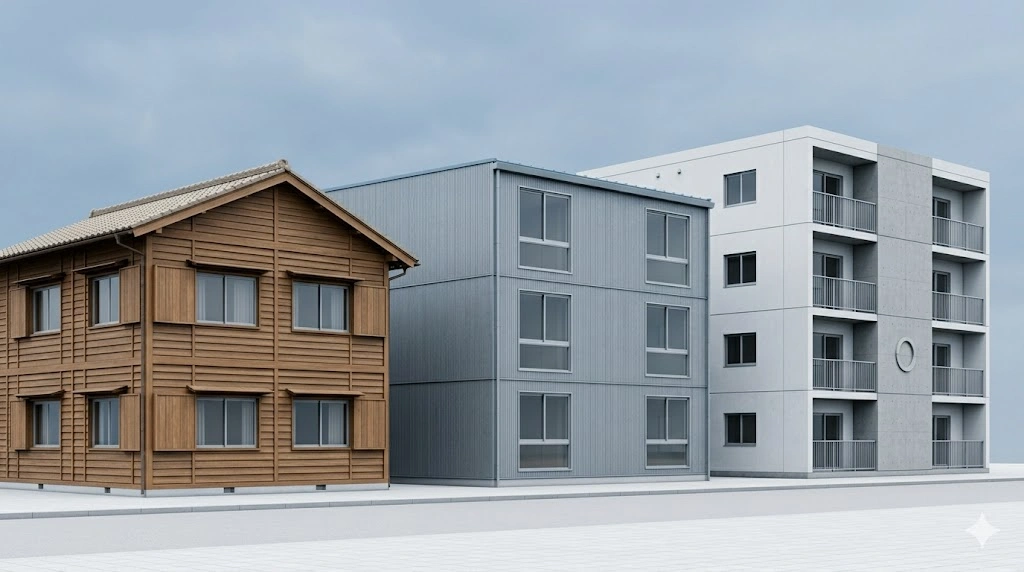
Japanese Building Structure and Depreciation: Wood vs. Steel vs. RC
What You Will Learn
Q. Why do wooden buildings depreciate faster than other structures in Japan?
Q. What are the Japanese useful lives for steel-frame buildings?
Q. Can a used reinforced concrete (RC) building be depreciated in 4 years?
Q. How does Japan's structure-based useful life compare to the U.S.?
Status as of April 2026: In force. Statutory useful lives are set by the Ordinance on Useful Lives of Depreciable Assets (減価償却資産の耐用年数等に関する省令, 1965 Ministry of Finance Ordinance No. 15, Appendix 1 “Buildings”; NTA summary PDF). The used-asset simplified method is in Income Tax Act Enforcement Order Article 129. Last verified: 2026-04-18.
Note on currency: dollar conversions use an indicative rate of approximately ¥150 = US$1, rounded for readability.
The depreciation math in Japan starts with a single question: how was the building built? Wood, steel, or reinforced concrete? Each answer writes a different useful life into the tax code, and the differences are large enough to dominate the acquisition decision for anyone running the numbers.
For foreign investors coming from the U.S. system — where residential rental real estate depreciates over 27.5 years regardless of construction type or age — the Japanese approach is unfamiliar. Japan ties the useful life to structure, then applies a separate formula to compress used assets that have exceeded their statutory life. The combination produces the 4-year wooden schedule that anchors the accelerated-tax strategy, and it produces a 9-year minimum for RC that explains why luxury concrete apartments are rarely the right vehicle for aggressive tax planning.
This article maps the full structure table, shows the used-asset formula in action, explains why wood dominates, introduces the light-gauge steel option that fills a specific strategic gap, and compares the entire framework to the U.S. residential rule.
The Useful-Life Table
Japan’s residential statutory useful lives by structure:
| Structure | Statutory Useful Life | Used-asset (past statutory life) |
|---|---|---|
| Wood-frame (木造) | 22 years | 4 years |
| Light-gauge steel (軽量鉄骨, frame ≤ 3mm) | 19 years | 3 years |
| Light-gauge steel (frame > 3mm, ≤ 4mm) | 27 years | 5 years |
| Heavy-gauge steel (重量鉄骨, frame > 4mm) | 34 years | 6 years |
| Reinforced Concrete (RC, 鉄筋コンクリート) | 47 years | 9 years |
| Steel-Reinforced Concrete (SRC, 鉄骨鉄筋コンクリート) | 47 years | 9 years |
The 22-year wooden life is the shortest in the residential category. When combined with the used-asset simplified method — statutory life × 20%, rounded down — it produces the 4-year schedule that foreign tax planners identify almost immediately.
The Simplified Method Formula
For buildings that have already exceeded their statutory useful life at the time of purchase, the useful life is recalculated under Enforcement Order Article 129:
Used-asset useful life = Statutory useful life × 20% (fractions below one year dropped)
Applied by structure:
- Wood (22 years) × 20% = 4.4 → 4 years
- Light steel 3mm or less (19 years) × 20% = 3.8 → 3 years
- Light steel >3mm ≤4mm (27 years) × 20% = 5.4 → 5 years
- Heavy steel >4mm (34 years) × 20% = 6.8 → 6 years
- RC (47 years) × 20% = 9.4 → 9 years
For buildings still within their statutory life, a different formula applies: remaining life plus 20% of used years. A 20-year-old wooden building (within its 22-year life) computes as (22-20) + 20×20% = 2 + 4 = 6 years, not 4. The 4-year schedule requires the building to be past its statutory life.
Why Wood Dominates — The Annual Deduction Math
On a building value of ¥50 million (roughly $330K), annual depreciation by structure:
| Structure | Simplified method | Annual depreciation |
|---|---|---|
| Wood (4 years) | 4 years | ¥12,500,000 (~$83K) |
| Light steel (5 years) | 5 years | ¥10,000,000 |
| Heavy steel (6 years) | 6 years | ¥8,333,000 |
| RC (9 years) | 9 years | ¥5,555,000 (~$37K) |
For a top-bracket Japanese resident (55% combined marginal rate per NTA Tax Answer No. 2260 (Japanese)), the wooden annual deduction saves up to ¥6.9 million in tax each year for four years. The RC annual deduction saves roughly ¥3 million each year for nine years. Total deduction is identical (¥50 million either way), but the timing is completely different — wood concentrates the deduction into four high-bracket years, RC spreads it over nine.
Concentration matters for two reasons:
- Rate arbitrage. Deductions claimed at a 55% rate, followed by a sale taxed at the 20.315% long-term capital gains rate (after five years of ownership), produce a roughly 35-point spread. The faster the deduction is claimed, the larger this spread’s value in present-value terms.
- Income profile. A top-bracket earner expecting variable income — a finance executive with large bonus years, a founder anticipating exit liquidity, a professional facing a peak-earning window — benefits from compressing the deduction into those specific years.
Wood-frame used buildings under the 4-year simplified method maximize both effects.
The 5-Year Light-Gauge Steel Option
The 4-year wooden schedule has one operational drawback: Year 5. In the year after depreciation ends, rental income flows through untouched by any paper loss, producing a taxable-income spike that inverts the prior four years’ sheltering. The conventional solution — sell in Year 6 or later, after the 5-year long-term capital gains threshold clears — leaves Year 5 itself unprotected.
A light-gauge steel 3-story building with frame thickness between 3 mm and 4 mm (statutory life 27 years; used past 27 years = 5-year simplified depreciation) offers a bridging alternative.
| Year | Wood (4-year simplified) | Light steel 3-story (5-year simplified) |
|---|---|---|
| 1–4 | Depreciation shelter | Depreciation shelter |
| 5 | Unsheltered (income spike) | Final year of shelter |
| 6 | Long-term capital gains eligible — sell | Immediately post-shelter, long-term eligible — sell |
The wooden schedule is slightly higher on annual deduction, but the light-steel schedule produces cleaner cash-flow visibility around the sale. For investors sensitive to Year 5 as a transition year — particularly those with compressed holding windows driven by relocation or role changes — the light-steel 3-story option is worth evaluating alongside the wooden default.
Critical caveat: frame thickness must be confirmed. A 3-story building is not automatically medium-gauge steel. Some 3-story steel buildings use light-gauge (≤ 3mm) frames and depreciate over 19 years, not 27. The distinction is recorded in the building permit (建築確認申請書) and structural drawings. Visual inspection is unreliable. Getting the classification wrong invites audit reassessment of the depreciation schedule, with interest and penalty consequences.
How Foreign Investors Confirm Structure
For due diligence on a Japanese income property:
- Real estate registry excerpt (登記簿謄本 / 不動産登記簿) — the “construction” field on the title page lists the basic structure type, though not the frame thickness for steel
- Building permit document (建築確認申請書) — required for any building under the Building Standards Act Article 6 (建築基準法第6条). Records the full structural specification, including frame thickness for steel buildings. Request from the seller or managing firm.
- Fixed asset tax assessment certificate (固定資産税評価証明書) — available from the local municipal office, confirms the structure classification used for property tax purposes
- Structural calculation document (構造計算書) — for steel buildings, specifies frame thickness directly
For an off-market purchase, the seller’s agent should be able to produce all four. For a mass-market listing, the registry excerpt alone is often the starting point, with additional documents requested before contract.
The U.S. Comparison
For U.S. persons reporting Japanese property on their U.S. returns, the Japanese structure classification does not transfer. The U.S. uses a flat residential rental useful life of 27.5 years under MACRS (IRS Publication 946), regardless of construction type and regardless of the building’s age at acquisition.
| System | Residential rental treatment |
|---|---|
| Japan | Structure-dependent (22/19/27/34/47 years) + used-asset fast-track (4/3/5/6/9 years) |
| U.S. (MACRS GDS) | Flat 27.5 years, no structure variance, no age fast-track |
| U.S. commercial (MACRS GDS) | Flat 39 years |
A 25-year-old Japanese wooden apartment placed in service on April 1, 2026, depreciates:
- On the Japanese return: 4 years remaining, ¥12.5M/year on a ¥50M building value
- On the U.S. return: 27.5 years, approximately $12,000/year on a $333K cost basis (using ¥150 = $1)
The schedules run entirely independently. There is no reconciliation obligation between them. The U.S. return reports MACRS depreciation against U.S.-taxed rental income; the Japanese return reports simplified-method depreciation against Japanese-taxed rental income. Foreign tax credit (Form 1116) links only the tax paid side, not the depreciation schedules themselves.
This is the structural source of why the 4-year Japanese strategy produces outsized benefit for U.S. persons on the Japanese return. The Japanese rules are simply faster — shorter useful life on old wooden buildings — and the U.S. system has no comparable acceleration for used residential property.
When to Reach Past Wood
Wood-frame used buildings dominate for tax purposes, but the right choice depends on the investor’s full profile:
- Accelerated tax shelter, short hold (4–6 years): Wood, 22 years or older. The default. ¥50M+ building value with high building-to-total ratio.
- Slightly softer tax benefit, cleaner Year 5 handoff: Light steel 3-story (3mm<x≤4mm frame, 27+ years old). 5-year schedule aligns with long-term capital gains timing.
- Longer hold, stable cash flow, limited tax emphasis: RC, 25–35 years old. Longer useful life, longer financing tenor, higher residual value, much smaller annual deduction.
- Maximum acceleration, minimum flexibility: Light steel with ≤3mm frame (19-year life, 3-year simplified). Property inventory is limited.
For a ¥500M+ ultra-luxury acquisition where tax efficiency is one of several objectives — not the only objective — the conversation typically converges on two options: used wood for maximum acceleration, or light-steel 3-story for cleaner Year 5 timing. RC rarely enters serious consideration as a tax vehicle at this price point.
Structure Mislabels and Audit Risk
Several common mislabels produce material differences in depreciation:
Light steel represented as heavy steel. Visual inspection cannot distinguish the two. A building permit verification is required. An investor depreciating a 3mm-frame structure over 6 years instead of 3 years claims half the legitimate annual deduction.
“Steel structure” registry entry with no frame thickness. The default registry field may read “steel” without detail. Frame thickness is in the building permit, not the registry. Proceeding on the registry alone risks mis-classification.
RC represented as eligible for the 4-year schedule. This is not a subtle error. RC never qualifies for the 4-year schedule. A pitch claiming otherwise is either uninformed or deliberately misleading; either way, the pitch fails on the actual tax return.
Age measured from registration rather than construction completion. The useful life depends on elapsed years since construction, not since purchase or registration. A 21-year-old building purchased a year later is 22 years old at the point of the depreciation determination. The simplified method requires the building to be past its statutory life — this is the line.
Related Reading
- 4-Year Depreciation on Used Wooden Buildings — the core strategy this structure comparison supports
- Placed-in-Service Date in Japan — when the depreciation clock starts
- When Does Depreciation Start? First-Year Month Rules — month-based allocation mechanics
- Japanese Real Estate Tax Basics for Foreign Investors — the broader framework
This article is for general informational purposes only and does not constitute tax advice. Consult a qualified tax professional for guidance on your specific situation. U.S. readers: per IRS Circular 230, nothing in this article may be used to avoid penalties under the Internal Revenue Code.
Japan Real Estate Inquiries
Property introductions, valuations, transaction issues, tax matters — feel free to reach out about anything related to Japan real estate.
Contact Us