Stamp Duty, Registration Tax, and Real Estate Acquisition Tax: Closing Costs Explained
For a Hong Kong-based advisor whose client is buying property in Japan, the question that determines whether a deal pencils — and whether the cash plan works — is rarely “what is the price” but “what are the closing costs.”
Japan imposes three separate one-time taxes at the acquisition stage. None of them is large in isolation, but they arrive at three different times, are calculated on three different bases, and are governed by three different statutes. Together with brokerage and the judicial scrivener, they make up Japan’s total acquisition cost of roughly 6-10% of the price — about 6% for investment-use residential property with current reductions, and more for hotels and other commercial buildings. The largest tax, the Real Estate Acquisition Tax, is billed 3-6 months after closing, which is why cash plans so often undercount it.
This article is the per-tax deep-dive and the series’ single reference for acquisition-stage rates. For the process, the parties involved, and the document checklist, see the companion Buying Property in Japan as a Foreign Investor or Company. For hotel and commercial purchases, see the dedicated section below.
Status as of September 2026: All tax rates, reductions, and statute references reflect the law as of this date (revised 2026-09-21: corrected the scope and statute of the land base reduction, and added the hotel and commercial section). The current reduction period for stamp duty (Special Taxation Measures Act §91), registration tax on land (§72), and Real Estate Acquisition Tax (Local Tax Act Supplementary Provisions §11-2) runs through March 31, 2027 — extended for three years by the FY2024 Tax Reform (令和6年度税制改正), continuing a pattern of two- to three-year extensions repeated since the original measures were introduced in the late 1990s. Currency reference: JPY 1 ≈ USD 0.0064 ≈ HKD 0.050 as of April 2026 (illustrative; rates fluctuate). Last verified: 2026-09-21.
At a Glance — Three Acquisition Taxes Compared
| Tax | Statutory authority | Tax base | Headline rate (residential) | When paid | Effective rate (¥500M Tokyo apt) |
|---|---|---|---|---|---|
| Stamp duty (印紙税 Inshi-zei) | Stamp Duty Act, Schedule 1 No.1 | Contract amount | ¥60,000 (over ¥100M up to ¥500M, reduced rate) | At contract signing | ~0.01-0.03% |
| Registration tax (登録免許税 Toroku Menkyo-zei) | Registration and License Tax Act §9 + Schedule 1 | Assessed value (固定資産税評価額) | Land 1.5% + Building 0.3% (residential) or 2.0% (other) | At closing (via judicial scrivener) | ~0.7-1.5% |
| Real Estate Acquisition Tax (不動産取得税 Fudosan Shutoku-zei) | Local Tax Act §73-2~§73-34 | Assessed value (固定資産税評価額) | 3% (residential land + building) or 4% (commercial building) | 3-6 months after closing | ~1.5-3% |
The three taxes share two important traits worth flagging at the start. First, registration tax and Real Estate Acquisition Tax both calculate on the assessed value (固定資産税評価額), not the purchase price — and the assessed value typically lands at 60-80% of market price. This is why the headline rates do not translate directly into the cost of the transaction. Second, the reductions on all three are time-limited and have been extended multiple times since the 1990s. The current period runs through March 31, 2027.
For HK advisors, the practical takeaway is that closing-day cash needs cover stamp duty + registration tax (both due at closing), but the largest single component — Real Estate Acquisition Tax — does not bill until months later. Clients budgeting only for closing-day items consistently undercount their total acquisition cash requirement.
Stamp Duty (Inshi-zei) — Contract Document Tax
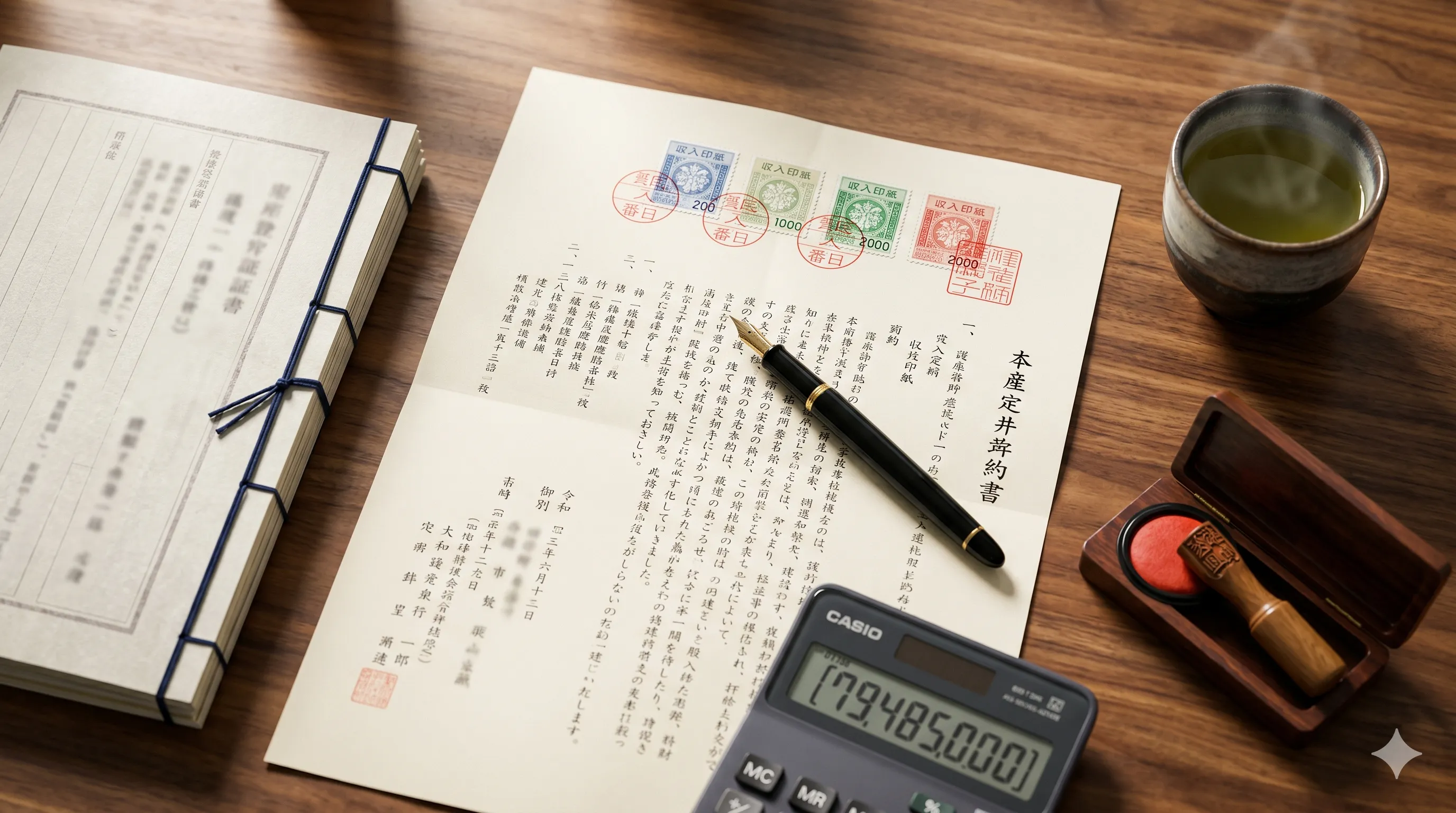
Stamp duty is the simplest of the three taxes. Under the Stamp Duty Act (印紙税法), tax is imposed on specific categories of taxable documents (課税文書) listed in Schedule 1. A real estate sale and purchase agreement falls under Schedule 1, No.1 (1) (“Documents evidencing the transfer of real estate”). The contract is “stamped” by affixing physical revenue stamps (収入印紙) to the document, valued at the amount specified in the schedule for the contract sum.
Rates for HK-typical transactions
The amount depends on the contract sum. Under Special Taxation Measures Act §91, reduced rates apply to real estate sale contracts executed between April 1, 2014 and March 31, 2027. For the contract amounts HK clients typically transact:
| Contract amount | Reduced stamp (until 2027-03-31) |
|---|---|
| Over ¥50M, up to ¥100M | ¥30,000 |
| Over ¥100M, up to ¥500M | ¥60,000 |
| Over ¥500M, up to ¥1B | ¥160,000 |
| Over ¥1B, up to ¥5B | ¥320,000 |
| Over ¥5B | ¥480,000 |
Stamp duty is small enough relative to total closing costs that for advisor briefing it can be treated as a fixed item in the ¥30k-¥320k range; the broker or judicial scrivener applies the correct stamp at contract signing. The full bracket schedule (including amounts under ¥50M and the ¥10B+ tiers) is published in NTA Tax Answer No.7140.
How it is paid
Physical revenue stamps are purchased at any post office, tax office, or registered tobacco/stationery shop and affixed to each original of the sale contract. Both seller and buyer typically retain an original each, and the contract is dual-stamped — meaning each party pays their own stamp duty. (In practice, the parties sometimes agree that one party prepares only one original and the other receives a photocopy to economize on stamp duty; this is permissible because Schedule 1 applies only to original taxable documents.)
After affixing the stamp, the parties cancel it (消印) by overlapping a hanko or signature across the boundary of stamp and contract paper — proving the stamp was used for this specific document. A missing stamp or a missing cancellation does not invalidate the contract, but each carries a penalty (過怠税, katai-zei) under Stamp Duty Act §20, and the two are calculated differently. For a missing stamp, the penalty is three times the unpaid duty (the duty plus twice the duty), reduced to 1.1× if the omission is self-reported before the tax office initiates an audit. For a contract over ¥500M up to ¥1B, that is ¥480,000 versus ¥176,000. For a stamp that was affixed but not cancelled, the penalty equals the face value of the uncancelled stamp. See NTA Tax Answer No.7131 for the official guidance.
Electronic contracts in practice
In principle, contracts executed entirely in electronic form (PDFs with e-signatures, no paper original) do not incur stamp duty — NTA administrative guidance confirms this. In practice, however, electronic contracting remains rare in actual Japan real estate transactions, especially at the high-value end. The contract-signing moment is treated as conveying the weight of the transaction, the judicial scrivener’s in-person closing review is built around physical originals, and for high-value properties paper signing is part of the defense against organized real estate fraud (地面師, jimenshi). In every HK-buyer transaction we have observed since beginning Hong Kong-Japan deal involvement in 2018, closing has used paper contracts with affixed revenue stamps; we have not encountered an electronic-only execution for an inbound HK acquisition over this period. HK clients should expect paper contracts and the corresponding stamp duty cost as the default; electronic contracting is exceptional rather than an emerging norm.
NTA reference: Tax Answer No.7140 — Stamp duty on real estate sale contracts (Japanese only).
Registration Tax (Toroku Menkyo-zei) — Title Transfer Tax
Registration tax is paid at the moment of title registration — the legal step that transfers ownership in the public real estate registry (不動産登記簿). Under the Registration and License Tax Act (登録免許税法) §9 and Schedule 1, every registration of a real right (登記) — ownership transfer, mortgage creation, leasehold registration — triggers tax.
For foreign buyers, this is the tax handled mechanically: the judicial scrivener (司法書士) calculates and pays it on the buyer’s behalf at closing, using funds wired from the buyer in advance. The buyer never deals with the tax office directly for this tax.
Rates
The Act sets statutory rates; the Special Taxation Measures Act provides time-limited reductions. As of 2026:
| Registration type (purchase by sale) | Statutory rate | Reduced rate (until 2027-03-31) |
|---|---|---|
| Land — ownership transfer | 2.0% | 1.5% (Special Taxation Measures Act §72) |
| Building — ownership transfer (non-residential or investment use) | 2.0% | No reduction |
| Building — ownership transfer (owner-occupied residential) | 2.0% | 0.3% (Special Taxation Measures Act §73) |
Mortgage creation, inheritance transfer, and gift transfer carry separate rates; covered in the relevant articles in this series.
The owner-occupied residential reduction at 0.3% (Special Taxation Measures Act §73) requires that the building be used as the buyer’s primary residence within one year of acquisition, with a minimum floor area of 50 square meters and other technical conditions. Investment-purpose acquisitions — including most HK-resident purchases of Tokyo property — apply the 2.0% statutory rate for the building. Land receives the 1.5% reduction regardless of use.
Tax base: assessed value, not purchase price
The base is the assessed value (固定資産税評価額) recorded on the municipal tax ledger as of January 1 of the year of acquisition. The judicial scrivener obtains the official certificate (固定資産評価証明書) from the municipal tax office.
For typical Tokyo central-ward residential property, the assessed value tends to land in these ranges relative to market price:
- Land: 70-80% of published Land Value (公示地価). Published Land Value, in turn, often runs at 80-90% of actual transaction prices in central Tokyo. Combined: assessed land value is typically 60-70% of market price.
- Building: 50-70% of construction cost when new, depreciating over time per the Fixed Asset Valuation Standards. For a new luxury condominium, assessed building value usually runs 40-50% of the building portion of purchase price.
This is why headline registration tax rates of 1.5-2.0% on assessed value translate to roughly 0.7-1.5% on purchase price in practice. For an HK advisor’s briefing, that range is the right level of precision; the judicial scrivener calculates and pays the exact amount at closing once the assessed value certificate is issued.
NTA reference: Tax Answer No.7191 — Registration tax on real estate (Japanese only).
Real Estate Acquisition Tax (Fudosan Shutoku-zei) — One-Time Prefectural Tax
The Real Estate Acquisition Tax is the largest of the three acquisition-stage taxes and the one most likely to surprise HK clients — both because of its absolute size and because it arrives months after the closing party is over.
It is a prefectural tax levied by the prefecture in which the property is located, under the Local Tax Act (地方税法) §73-2 through §73-34. Tokyo Metropolitan Government (Tokyo-to) administers it for properties in Tokyo’s 23 wards, Tama, and the islands; other prefectures collect their own.
Rates
The Local Tax Act sets a 4% statutory rate (§73-15). Two time-limited reductions apply through March 31, 2027 under Local Tax Act Supplementary Provisions §11-2:
| Asset type | Statutory rate | Reduced rate (until 2027-03-31) |
|---|---|---|
| Land (all uses) | 4.0% | 3.0% |
| Building — residential | 4.0% | 3.0% |
| Building — non-residential (commercial, office, retail) | 4.0% | 4.0% (no reduction) |
Tax base reductions
Further reductions apply to land and to residential property. Some are applied on the basis of the buyer’s acquisition declaration, which the judicial scrivener does not file; the buyer’s tax accountant or the buyer does.
Land — 1/2 base reduction (Local Tax Act Supplementary Provisions §11-5): For land assessed as building land (宅地評価土地 — building land and land valued in line with it) acquired through March 31, 2027, the assessed value is halved before applying the 3% rate. This is not limited to residential land — it applies to land under offices, retail, and hotels as well — and it has no owner-occupied requirement.
Residential land — tax credit (Local Tax Act §73-24): A credit against the tax on land under a qualifying residence. The amount depends on the land’s assessed value per square meter and the floor area of the residence. Whether it applies follows the building: land under a newly built qualifying residence can qualify whether or not the owner lives there; land under a pre-owned residence qualifies only when an individual acquires it as their own home. The prefectural tax office calculates the exact credit.
Residential building deduction (Local Tax Act §73-14): A deduction from the building’s assessed value before the 3% rate. Newly built housing (generally 50-240 m² per unit; 40 m² or more for rental units in apartment buildings) receives ¥12M, and this includes housing bought to rent out. Pre-owned housing receives a graduated amount by construction year, up to ¥12M, but only when an individual acquires it as their own home — so a pre-owned unit bought for rental gets no building deduction.
For a HK buyer of a pre-owned unit for rental — the most common case — the reductions that apply are the 3% rate and the 1/2 base reduction on the land; the building deduction and land credit do not. A newly built unit bought for rental can still receive the new-housing deduction if it meets the floor-area conditions. Note also that the deductions are fixed amounts: on a high-value unit, a ¥12M deduction from assessed value is worth at most ¥360,000 of tax at 3%, so they matter far less at the top of the market than at typical price points.
Notification and payment
Each prefecture’s tax office sends the assessment notice (納税通知書) to the buyer’s address of record approximately 3 to 6 months after closing — though some prefectures take up to 12 months on complex cases. The notice specifies the tax amount, the payment deadline (typically 30 days from notice), and the payment slip.
For non-resident buyers without a Japanese address, the notice goes to the Tax Agent (Nozei Kanrinin, 納税管理人) — a Japan-resident representative appointed under the Act on General Rules for National Taxes §117 for national taxes, and under the Local Tax Act and prefectural ordinances for prefectural taxes including Real Estate Acquisition Tax. Without a Tax Agent, the notice may not reach the buyer in time to pay by the deadline, and late-payment charges can follow. Appointing the Tax Agent is therefore best treated as a closing-stage task, not a post-closing one.
The buyer should also file a Real Estate Acquisition Declaration (不動産取得申告書) with the prefectural tax office by the deadline set by prefectural ordinance (Tokyo: within 30 days of acquisition). The declaration is how the deductions and credits are claimed; if it is not filed, the first assessment may not reflect them, and correcting it takes additional steps.
Tokyo Metropolitan Government reference: Real Estate Acquisition Tax page (Japanese; English summary at “Guide to Real Property Tax”).
Illustrative Magnitudes — ¥500M Tokyo Minato-ku Apartment (HK Resident, Rental Investment)
Briefing-grade illustration, not a deliverable. Exact tax amounts depend on the property’s assessed value, land/building allocation, floor area, and use classification — all of which are determined per-property. The figures below show typical orders of magnitude HK advisors can use in an early client conversation to convey structure and scale; the judicial scrivener and tax accountant produce the precise numbers once a specific property is selected.
Scenario: ¥500M pre-owned tower condominium unit in Minato-ku, HK-resident individual buyer, rental-investment use (not owner-occupied), closing before March 31, 2027 with current reductions applied. Because the unit is pre-owned and not the buyer’s home, no building deduction or land credit applies.
Assumptions (stated so the arithmetic can be checked and replaced with real figures): assessed value of the land share ¥150M and of the building ¥150M — together about 60% of the price. In a real tower condominium the land share is often smaller; the scrivener’s assessed-value certificate replaces these numbers.
| Tax | Calculation | Amount | When |
|---|---|---|---|
| Stamp duty | Over ¥100M up to ¥500M, reduced rate | ¥60,000 | Contract signing |
| Registration tax — land | ¥150M × 1.5% | ¥2,250,000 | At closing |
| Registration tax — building | ¥150M × 2.0% (investment use, no 0.3% reduction) | ¥3,000,000 | At closing |
| Acquisition tax — land | ¥150M × 1/2 × 3% | ¥2,250,000 | 3-6 months after |
| Acquisition tax — building | ¥150M × 3% (residential; pre-owned rental, no deduction) | ¥4,500,000 | 3-6 months after |
| Total acquisition-stage taxes | ¥12,060,000 (≈ 2.4% of price) |
Add brokerage (3% + ¥60,000 + tax ≈ ¥16.6M) and the judicial scrivener (roughly ¥0.5-0.8M for a foreign-buyer file), and total acquisition costs come to roughly ¥29-30M, or about 6% of the price — the lower end of the 6-10% range, because residential rate reductions apply.
Owner-occupied vs. investment use matters less than often assumed at this price. If an individual bought the same unit as their own home, the building deduction (up to ¥12M of assessed value, §73-14) and the land credit (§73-24) would apply — but on a ¥150M building assessment, a ¥12M deduction saves at most ¥360,000. The registration tax reduction to 0.3% for an owner-occupied home would matter more. For HK clients buying for rental, the investment-use case above is the relevant baseline.
What the HK advisor’s role is here
For early-stage client conversations, the structure and scale above are sufficient. The numbers an advisor needs to flag:
- About 6% total acquisition cost for investment-use residential property with current reductions
- About three-quarters of it paid at or before closing (brokerage, registration tax, scrivener, stamp duty), and the rest — the acquisition tax — billed 3-6 months later
- Owner-occupied carries materially lighter acquisition tax; rental investment does not
- Hotels and other commercial buildings cost more; see the next section
Anything more precise — assessed value lookups, exact land/building split, deduction eligibility for a specific structure, prefectural filing logistics — belongs to the Japanese tax accountant (税理士) the buyer engages, working with the judicial scrivener (司法書士) at closing. An HK advisor’s value is in flagging that those professionals must be engaged before the closing schedule firms up, not in producing the calculations themselves.
Hotel and Commercial Acquisitions
Most foreign-buyer guides stop at residential property. Hotels, office buildings, and retail buildings follow the same three taxes, but the reductions work differently, and the difference is large enough to change a budget.
Which rates apply — land and building separately
| Item | Land | Building (hotel, office, retail) |
|---|---|---|
| Registration tax | 1.5% of assessed value (until 2027-03-31) | 2.0% of assessed value (no reduction) |
| Real Estate Acquisition Tax — rate | 3% (until 2027-03-31) | 4% (no reduction) |
| Real Estate Acquisition Tax — base | Assessed value × 1/2 for building land (Supp. §11-5), including hotel land | Full assessed value |
| Owner-occupier deductions | Not applicable | Not applicable |
Two points are easy to get wrong. First, the 3% acquisition tax rate covers land of any use, but for buildings it covers only residential buildings — a hotel building is taxed at 4%. Second, the 1/2 base reduction for land is not a residential measure: it applies to land assessed as building land, so it reduces the tax on hotel and office land too.
Illustrative example — ¥1B hotel
Assumptions: purchase price ¥1B excluding consumption tax; assessed value of the land ¥400M and of the building ¥300M; direct acquisition of the real estate; closing before March 31, 2027. When the seller is a business, the building portion of the price is also subject to 10% consumption tax, which is separate from the taxes below and not included in this example.
| Tax | Calculation | Amount |
|---|---|---|
| Stamp duty | Over ¥500M up to ¥1B, reduced rate | ¥160,000 |
| Registration tax — land | ¥400M × 1.5% | ¥6,000,000 |
| Registration tax — building | ¥300M × 2.0% | ¥6,000,000 |
| Acquisition tax — land | ¥400M × 1/2 × 3% | ¥6,000,000 |
| Acquisition tax — building | ¥300M × 4% | ¥12,000,000 |
| Total acquisition-stage taxes | ¥30,160,000 (≈ 3.0% of price) |
With brokerage and scrivener fees on top, a direct hotel acquisition lands around 6.5-7% of the pre-consumption-tax price in this example — higher than the residential case, mainly because of the 4% rate on the building. Operating hotels also bring costs outside these three taxes (license transfers, operator contract review, and equipment that may be taxed separately as depreciable assets), which are not covered here.
Buying through trust beneficial interests (TBI)
Larger hotels and commercial buildings in Japan often change hands not as real estate but as trust beneficial interests (信託受益権): the property sits in a trust with a trust bank as the registered owner, and the buyer acquires the beneficiary’s position. The tax treatment of that transfer is different from a direct purchase:
| Item | Direct purchase of the real estate | Transfer of the trust beneficial interest |
|---|---|---|
| Real Estate Acquisition Tax | Levied (as above) | Not levied — the buyer acquires the beneficial interest, not the real estate |
| Registration tax | 1.5% (land) / 2.0% (building) of assessed value | The registered change is to the beneficiary entry; registration tax is ¥1,000 per property |
| Stamp duty | Real estate sale contract rates | Different document classification; confirm with the scrivener |
Three qualifications matter, and each describes a different transaction from the one above:
- Putting the property into trust is a separate registered event on the seller’s side, with its own registration tax. A trust bank must also agree to accept the asset, which is common for hotels and larger buildings and uncommon for small ones. Annual trust fees apply for as long as the trust continues
- Ending the trust so that the beneficiary takes title directly is another separate event, and it can trigger registration tax and Real Estate Acquisition Tax. How it is taxed depends on the facts, including who originally placed the property in trust
- Financing and structure usually drive the choice of a TBI more than the transfer taxes do. The holding structures that use TBIs are covered in How Hong Kong Companies Hold Japan Real Estate and Structure Comparison
The judicial scrivener and tax accountant confirm the treatment for a specific property; the table above is a map of where the differences are, not a calculation.
Reduced Rates for Residential Property — Summary
The residential reductions are the structural reason total acquisition costs vary as widely as they do between owner-occupied and investment-use foreign-buyer scenarios. The key matrix:
| Reduction | Applies to | Owner-occupied requirement | Statute |
|---|---|---|---|
| Stamp duty reduction (Schedule 1 No.1) | All real estate sale contracts | None | Special Taxation Measures Act §91 |
| Registration tax — land 1.5% | Land in any sale transaction | None | Special Taxation Measures Act §72 |
| Registration tax — residential building 0.3% | Residential building transfer | Yes (50+ m², primary residence within 1 year) | Special Taxation Measures Act §73 |
| Acquisition tax 3% rate | Land + residential building | None | Local Tax Act Supp. §11-2 |
| Acquisition tax — land 1/2 base reduction | Building land of any use (宅地評価土地) | None | Local Tax Act Supp. §11-5 |
| Acquisition tax — residential land tax credit | Land under qualifying housing | New housing: no. Pre-owned: yes (individual, own home) | Local Tax Act §73-24 |
| Acquisition tax — building ¥12M deduction (new) | Newly built housing, floor-area conditions | No — rental housing qualifies | Local Tax Act §73-14 ¶1 |
| Acquisition tax — building graduated deduction (pre-owned) | Pre-owned housing, floor-area and earthquake-resistance conditions | Yes (individual, own home) | Local Tax Act §73-14 ¶3 |
For HK-resident investors buying pre-owned property for rental, the reductions that apply are: the stamp duty reduction, registration tax land 1.5%, acquisition tax 3%, and the land 1/2 base reduction. Buying newly built rental housing adds the new-housing deduction. Presenting a purchase as “owner-occupied” purely to capture deductions carries documentary and tax-residence consequences and is rarely worth it for non-resident buyers.
Timing of Each Tax — When You Pay What
| Stage | Tax | Trigger | Recipient |
|---|---|---|---|
| Contract signing | Stamp duty | Affixing revenue stamp on the SPA | Self-affixed, no recipient |
| Closing day | Registration tax | Filing of ownership-transfer registration | National Treasury (paid via judicial scrivener) |
| 3-6 months after closing | Real Estate Acquisition Tax | Receipt of prefectural tax notice | Prefectural government |
Two operational consequences for HK clients:
1. The closing-day cash plan must include stamp duty and registration tax, but NOT acquisition tax. Buyers who allocate exactly 6% of purchase price to closing-day costs and assume “all taxes paid” face a second, larger bill 3-6 months later.
2. The Tax Agent should be in place before the prefectural tax office sends the acquisition tax notice. Without one, the notice may not reach the buyer before the payment deadline, and late-payment charges can follow. Appointing the Tax Agent is the buyer’s responsibility; treat it as part of closing.
For HK advisors, the practical consequence is that the closing-stage budget conversation should explicitly separate “closing-day cash” (covering stamp duty + registration tax + brokerage + judicial scrivener) from “post-closing cash reserve” (covering Real Estate Acquisition Tax + first Fixed Asset Tax installment + first year operating costs). Clients pleased with the closing-day total often forget the post-closing reserve until the prefectural tax notice arrives.
For ongoing annual property taxes (Fixed Asset Tax + City Planning Tax), see Annual Property Taxes in Japan.
Key References
Primary statutes:
- Stamp Duty Act (印紙税法) — Schedule 1 No.1 for real estate sale contracts; §20 for penalties on unstamped documents
- Registration and License Tax Act (登録免許税法) — §9 (rate), §10 (tax base), Schedule 1 (rate table by registration type)
- Local Tax Act (地方税法) — §73-2 to §73-34 for Real Estate Acquisition Tax; §73-14 for residential building deductions
- Special Taxation Measures Act (租税特別措置法) — §72 (registration tax land reduction), §73 (residential building reduction), §91 (stamp duty reduction)
- Local Tax Act Supplementary Provisions §11-2 (acquisition tax 3% rate), §11-5 (1/2 base reduction for building land); Local Tax Act §73-24 (residential land tax credit)
Government information sources:
- NTA Tax Answer No.7140 — Stamp duty on real estate sale contracts (Japanese)
- NTA Tax Answer No.7191 — Registration tax overview (Japanese)
- Tokyo Metropolitan Government — Real Estate Acquisition Tax (Japanese; refer to your prefecture for properties outside Tokyo)
- Ministry of Internal Affairs and Communications — Fixed Asset Valuation Standards — basis for assessed value calculations (Japanese)
Treaty:
- Japan-Hong Kong Tax Treaty (2010) — Not applicable to the three acquisition-stage taxes (these are transaction taxes outside the treaty’s income-tax scope). Treaty relevance arises in rental income (Article 6) and capital gains (Article 13), covered in the rental income and sale articles in this series.
Related articles in this series:
- Buying Property in Japan as a Foreign Investor or Company — Process, roles, and timeline
- HK Professional Advisor Primer: 10-Minute Reference — Hub article with links across the full guide series
- 5 Critical HK-Japan System Differences — Why backloaded acquisition tax and broker-account settlement catch HK advisors
- Hong Kong vs. Japan Tax Comparison — Conceptual frame for the multi-stage taxation model
- Annual Property Taxes in Japan — Fixed Asset Tax and City Planning Tax after acquisition
- Rental Income Taxation for Non-Resident Owners
- Selling Japan Property as a Non-Resident: 10.21% Withholding
- How Hong Kong Companies Hold Japan Real Estate — Direct, GK, and GK + trust beneficial interest structures
For Professional Advisors
If you are a Hong Kong-based lawyer, banker, tax counsel, or family office advisor structuring a Japan property acquisition, this article is written to be shareable as client briefing material. The numerical assumptions in the illustrative magnitudes (assessed-value-to-market-price ratios, land/building split, residential vs. commercial classifications) require verification against the specific property — the judicial scrivener obtains the assessed value certificate at closing, and a Japanese tax accountant should confirm whether owner-occupied deductions can be claimed for a particular structure. We’re available for case-specific discussions on regular Hong Kong visits; feel free to share this article with clients or contact us via /contact/.
7vip.tokyo is operated by Acuze G.K., a licensed real estate broker (Tokyo Governor License (1) No. 112235). Founder Takaharu Saito is a member of the American Chamber of Commerce in Japan (ACCJ), with established networks across English-speaking high-net-worth and professional-services communities, and has been engaged with Hong Kong’s Japan real estate investment community since 2018 through bi-monthly visits and partnership with a Japanese-led HK-based wealth management firm; see our Company Profile for background.
This article is for general informational purposes only and does not constitute legal, tax, or investment advice. Tax rates, reductions, and procedural requirements change; the specifics described above reflect the law as of September 2026 and should be verified for transactions advised after that date. Consult a qualified Japanese tax accountant (税理士) and licensed real estate broker for guidance on your specific situation.
Frequently Asked Questions
Q. How is the tax base (assessed value) determined for registration tax and Real Estate Acquisition Tax?
Q. Are the reduced rates for stamp duty, registration tax, and Real Estate Acquisition Tax automatic, or does the buyer need to apply?
Q. When do the time-limited reductions expire, and what happens at expiry?
Q. Does stamp duty apply to electronic contracts (PDF or e-signature)?
Q. How does the Real Estate Acquisition Tax interact with the Japan-Hong Kong Tax Treaty?
Japan Real Estate Inquiries
Property introductions, valuations, transaction issues, tax matters — feel free to reach out about anything related to Japan real estate.
Contact Us