Three HK-Japan Real Estate Mechanics Without Direct HK Equivalents

The companion article in this series — HK Professional Advisor Primer: Six Foundations and Four Practical Questions — covers the foundational tax knowledge HK clients need: multi-stage taxation, depreciation, annual holding taxes, inheritance tax exposure, sale taxes, and the refund system.
This article covers the complement: three Japan real estate mechanics that have no direct Hong Kong equivalent, where the HK mental model offers no reference point at all. These are not just “Japan does it differently” — they are mechanics HK practice does not prepare an advisor to anticipate.
Status as of May 2026: All tax rates, procedural requirements, and treaty references reflect the law as of this date. Tax legislation changes — verify current law for transactions advised after the date in this article. Currency reference: JPY 1 ≈ USD 0.0064 ≈ HKD 0.050 as of April 2026 (illustrative; exchange rates fluctuate). Last verified: 2026-05-02.
1. The Important Matters Explanation: Front-Loaded Disclosure That Has No HK Equivalent
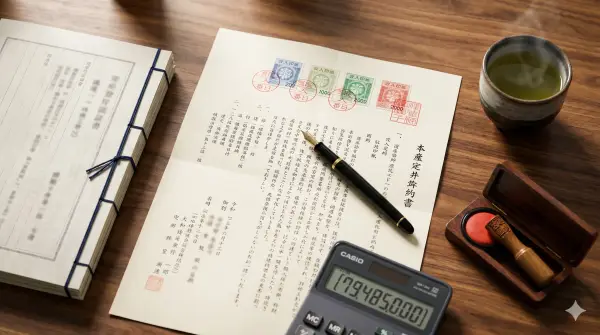
Hong Kong property transactions revolve around the formal Sale and Purchase Agreement and the Land Registry process, with due diligence typically conducted by the buyer’s solicitor between exchange and completion. Japan operates a different sequence: the sale contract (売買契約書) is preceded by a Japan-specific document with no direct HK equivalent — the Important Matters Explanation (重要事項説明書, juyo jiko setsumeisho).
This document, mandated by Real Estate Brokerage Act §35, must be delivered by a licensed broker (宅地建物取引士) and explained verbally to the buyer before the sale contract is signed. It covers legal restrictions on the property, infrastructure, building condition, title encumbrances, and other due-diligence items. For a HK lawyer who expects DD to be conducted between exchange and completion, this front-loaded explanation is a structural feature, not optional or postponable.
The buyer’s signature on the Important Matters Explanation creates a record of disclosure that limits the broker’s later liability. HK advisors should ensure their client receives a translated version (or has a Japanese-speaking advisor present at the explanation meeting) — not because translation is legally required, but because the document is the single best snapshot of property-specific risks at the moment of decision.
Source: Real Estate Brokerage Act §35 (Important Matters Explanation).
2. The Settlement Flow: HK Buyers Don’t Have JPY Accounts at Acquisition
In HK transactions, the buyer’s solicitor holds the deposit and final settlement runs on local same-day bank infrastructure between buyer and seller accounts. Japan’s settlement workflow for non-resident HK buyers is structurally different — and the difference has no direct HK equivalent.
HK buyers typically do not have a Japanese bank account at the time of acquisition, and overseas wires from HK to Japan settle T+2 to T+5. The standard settlement workflow therefore routes through the licensed broker’s account: the buyer wires JPY to the broker in advance of closing, and the broker disburses to the seller at settlement. The HK buyer’s own JPY balance only appears later, when a Japan-side corporate or personal account is opened to receive rental income and pay ongoing operating costs (management fees, property taxes, and the Real Estate Acquisition Tax bill that arrives 3-6 months later).
For HK advisors planning the closing timeline, this implies two preparation items that do not arise in HK transactions: (a) the wire delay (T+2 to T+5) needs to be priced into the closing schedule, and (b) the buyer will need a Japan-side operating account opened post-closing to handle the recurring outflows. Both are standard practice for the small subset of brokers that handle non-resident HK clients, but neither has a direct HK analog the advisor can lean on.
3. The Inheritance Awareness Gap (Beyond the Mechanics)
Hong Kong abolished estate duty on 11 February 2006. For HK lawyers and CPAs whose entire practice has been post-abolition, inheritance tax simply is not part of the daily mental model. Japan’s inheritance tax (相続税), with rates up to 55% above ¥600M and a “10-year rule” extending worldwide-asset exposure for those with prior Japanese resident status, sits outside that mental model entirely.
The mechanics — the three holding-structure cases (direct / HK corp / JP corp), the situs rules under Inheritance Tax Act §10, the 10-year rule — are covered in Foundation 4 of the companion primer. What the primer does not capture, and what is the genuinely unique observation here, is the awareness gap itself.
In our conversations with HK-based clients and advisors over multiple visits, we have repeatedly observed that HK professionals — including lawyers advising on cross-border investment matters — are unfamiliar with the existence of Japan’s inheritance tax at all. The reaction is often genuine surprise: a HK professional familiar with HK’s post-2006 estate-duty-free regime simply does not expect the Japan side to assert any inheritance taxing rights on the same fact pattern.
This matters not because HK clients are typically exposed (most are not — they hold through corporate structures that shield them under §10), but because the awareness gap can lead to structure-selection mistakes in edge cases: a client who acquires Japan property directly because no one raised the inheritance question, then later discovers the gap when restructuring is more expensive than upfront structuring would have been. The HK-advisor value-add is verifying the structure before the client is locked into it.
Source: Hong Kong Revenue (Abolition of Estate Duty) Ordinance 2005 (effective 11 February 2006); Japan Inheritance Tax Act §10 (situs rules).
Closing Note for HK Advisors
These three mechanics are not the entire delta between HK and Japan practice — for the broader tax foundations (multi-stage taxation, depreciation, annual ownership taxes, sale taxes, refund system), see the companion primer. What this article covers is specifically the points where HK practice offers no reference frame at all: the front-loaded Important Matters Explanation, the broker-mediated settlement flow for non-resident buyers, and the inheritance-awareness gap that no amount of tax mechanics covers.
An HK lawyer or CPA who internalizes these three points alongside the primer’s foundations is meaningfully better equipped to brief a client on a Japan acquisition.
Key References
- Real Estate Brokerage Act (宅地建物取引業法) — §35 Important Matters Explanation
- Inheritance Tax Act (相続税法) — §10 (situs rules — share situs follows corporate principal office)
- Hong Kong Revenue (Abolition of Estate Duty) Ordinance 2005 — effective 11 February 2006
Related Articles in This Series
Companion article:
- HK Professional Advisor Primer: Six Foundations and Four Practical Questions — Foundational tax knowledge: multi-stage taxation, depreciation, annual holding taxes, inheritance, sale taxes, refund system
Already published:
- A Foreign Investor’s Guide to Buying Property in Japan, Japan Real Estate Tax Basics for Foreign Investors, Hong Kong vs. Japan Tax Comparison, Structure Comparison, Long-Term Capital Gains.
For Professional Advisors
If you are a Hong Kong-based lawyer, CPA, private banker, or family office advisor, this article and the others in the series are written to be shareable as client briefing material. We visit Hong Kong approximately every other month and welcome in-person discussions of specific transactions, including dual-resident scenarios, corporate holding structures, pre-closing AML preparation, and inheritance planning. Together with our Hong Kong partner — a Japanese-led wealth management firm based there — we meet regularly with HK-based lawyers, family office CFOs, real estate professionals, and Big Four advisors. The five differences in this article are drawn directly from those conversations. Feel free to share this article with your clients, or contact us via /contact/ for case-specific consultation.
7vip.tokyo is operated by Acuze G.K. (est. 2021), a licensed real estate broker (Tokyo Governor License (1) No. 112235). Founder Takaharu Saito is a Licensed Real Estate Transaction Specialist (宅地建物取引士) and a Member of the American Chamber of Commerce in Japan (ACCJ). His engagement with Hong Kong’s Japan real estate investment community goes back to around 2018, when he led a series of Japan real estate investment seminars hosted in Hong Kong by Phillip Securities (PhillipCapital) while working at a condominium developer in Japan. The relationship built during that period continues today. See our Company Profile for full background.
This article is for general informational purposes only and does not constitute legal, tax, or investment advice. Tax rates, treaty provisions, and procedural requirements change; the specifics described above reflect the law as of May 2026 and should be verified for transactions advised after that date. Consult a qualified Japanese tax professional and a licensed real estate broker for guidance on your specific situation.
Frequently Asked Questions
Q. Why is the Japanese sale contract not the same as a Hong Kong SPA?
Q. Why do HK buyers settle through the broker's account rather than directly?
Q. Why are HK lawyers and CPAs typically unaware of Japan inheritance tax?
Japan Real Estate Inquiries
Property introductions, valuations, transaction issues, tax matters — feel free to reach out about anything related to Japan real estate.
Contact Us