Retail Properties
Off-market sectional retail units and tenant spaces in Minato-ku, Shibuya-ku, and Shinjuku-ku. Three property types and NET yield evaluation for commercial unit investment starting from tens of millions of yen.
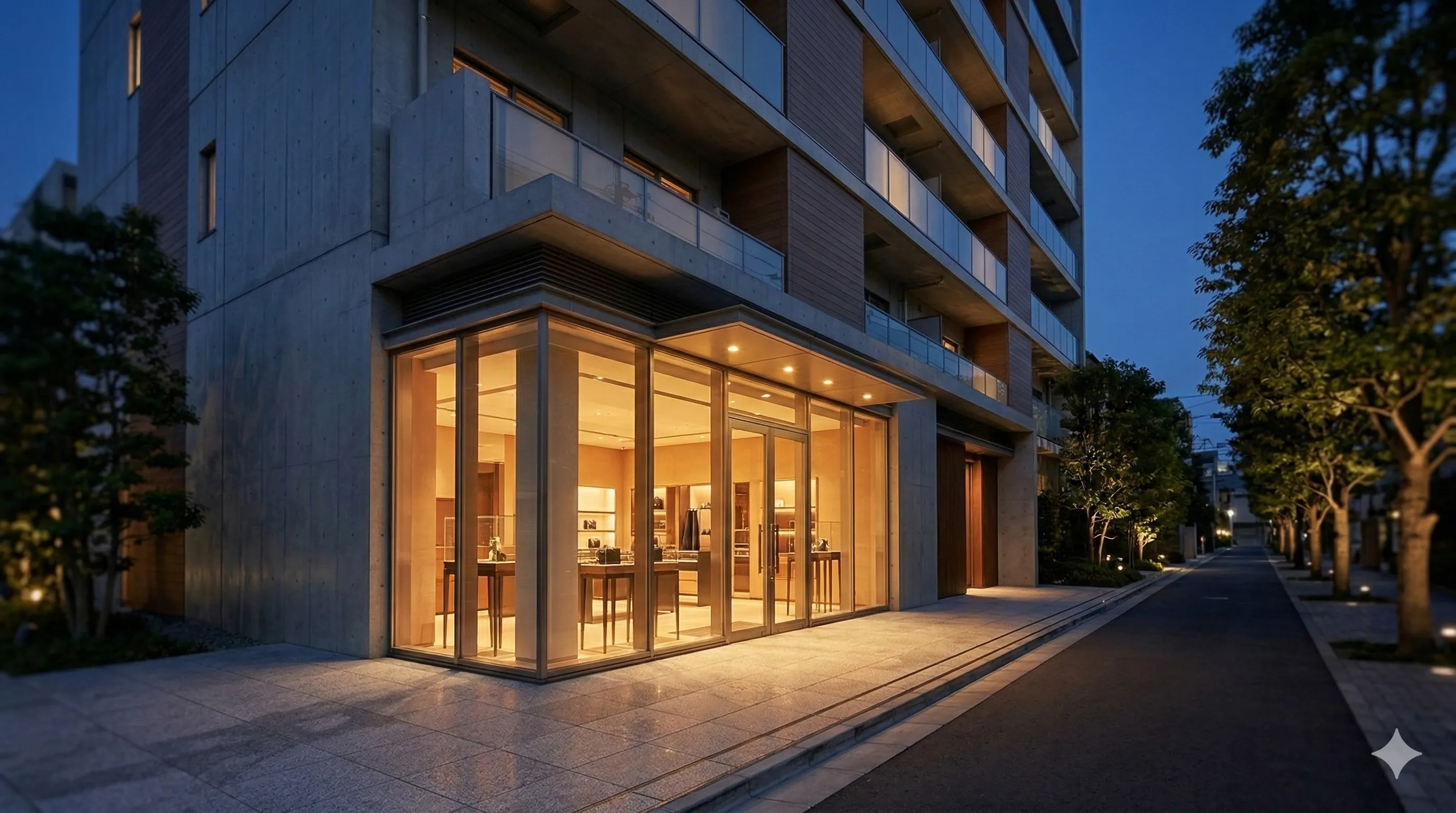
Sectional Retail & Tenant Spaces
Off-market commercial units from tens of millions to over ¥100 million
In real estate investment, whole-building income properties require capital in the hundreds of millions to tens of billions of yen. However, “sectional retail units” (kubun tempo) offer a way to enter prime urban commercial real estate starting from tens of millions to the ¥100 million range.
A sectional retail unit is an individually owned commercial space — typically on the basement or ground floor of a larger building — acquired through sectional ownership rights, with tenant rent as the revenue source. Compared to sectional condominium investment, these units offer higher gross yields, and properties in commercial districts can attract tenants at premium per-tsubo rent levels.
However, such properties rarely appear on REINS (the broker-to-broker property information network) or general investment property search sites. For properties with active tenants, leaked sale information can directly trigger tenant departure, so sellers enforce strict information control. Similarly, when whole-building owners sell individual units, information circulates only through limited channels out of consideration for the management association and other unit owners.
Based on the multiple sectional retail properties we have handled, here is what defines this category.
3 Types of Sectional Retail Units
Type 1: Luxury Residential Area Adjacent (Basement/Ground Floor Units in Large Condominiums)
Commercial spaces on the basement or ground floor of large RC condominium buildings. Exclusive areas range from 25–100㎡ (approximately 8–30 tsubo), and the surrounding environment tends to be quiet due to the residential setting.
Common characteristics of this type:
- Located within RC condominiums approximately 15–20 years old, with well-maintained building management by the owners’ association
- Management fees and repair reserve funds range from tens of thousands to approximately ¥70,000 per month, set according to building grade
- Relatively large exclusive areas accommodate diverse business types beyond food service — salons, clinics, galleries, and more
- Some properties provide access to residential building common facilities such as daytime management, elevators, and package lockers
For tenanted properties, acquisition as an owner-change investment is standard, with net income being the difference between current rent and management costs. As total monthly costs (management fees, repair reserves, and other charges) can exceed ¥70,000, verification based on NET yield — not just gross yield — is essential.
Type 2: Small-Scale Units in Commercial Districts (Entertainment Districts/Terminal Station Areas)
Small sectional retail units centered on basement floors of buildings in commercial districts. While compact at approximately 7–15 tsubo, these properties can command high per-tsubo rent backed by the location’s drawing power.
Key characteristics:
- Located near terminal stations accessible via multiple rail lines, with daily ridership in the hundreds of thousands to millions
- Flexible usage permitted by commercial zoning — light food service, 24-hour operation, and more
- Buildings are predominantly RC or SRC construction with three basement levels; basement floors offer lower per-unit rent than above-ground floors, making yield easier to secure
- Management fees and repair reserves are low at approximately ¥10,000 per month, keeping expense ratios down
Some cases offer acquisition prices in the tens of millions of yen with gross yields around 7% and NET yields near 7%, delivering superior profitability compared to sectional condominium investment. However, depending on the tenant’s industry and business type, susceptibility to economic fluctuations should be noted. Guarantee company enrollment status and the presence of inherited security deposits are important factors in risk assessment.
Type 3: Street-Level Retail in Office/Academic Districts (Retail-Office Hybrid Units)
Ground-floor street-level units in buildings located in office or academic districts. At approximately 25–30 tsubo, these mid-sized units offer high versatility, accommodating both retail and office use.
Characteristics of this type:
- Prime locations with access to 4+ stations on 5+ rail lines
- Located in solidly constructed SRC buildings with major general contractor construction and major management company oversight
- Suitable for diverse non-food-service uses including offices, studios, tutoring schools, and more
- Building common facilities favorable for tenant recruitment, such as lobby directory signage and shared restrooms
Properties adjacent to areas undergoing redevelopment offer potential for rent increases as the surrounding environment improves. Units with completed interior renovation enable immediate tenant recruitment, targeting early revenue realization through minimized vacancy periods. For properties with acquisition prices exceeding ¥100 million, careful verification of projected rent against surrounding market rates is necessary.
4 Evaluation Axes for Sectional Retail Investment
1. Profitability Verification via NET Yield
Unlike sectional condominiums, sectional retail units exhibit significant variation in management fee and repair reserve levels. Properties with the same gross yield can show major NET yield differences when monthly management costs are ¥10,000 versus ¥70,000. Additionally, some properties incur ancillary costs such as signage fees, yard usage fees, and management board cooperation fees, making comprehensive annual expense analysis essential for accurate yield calculation.
2. Tenant Industry and Contract Terms
When acquiring tenanted properties, thorough examination of the current tenant’s industry, contract type (standard lease vs. fixed-term lease), remaining contract period, and per-tsubo rent appropriateness is required. Food service tenants offer higher per-unit rent but carry risks of restoration costs upon departure, odor issues, and ventilation equipment problems that can affect subsequent tenant recruitment. Office and studio tenants offer somewhat lower per-unit rent but can be expected to provide long-term stable operation.
3. Management Association Operations and Bylaws
Unlike whole buildings, sectional retail properties are subject to management association decisions for overall building maintenance. Permitted business types, operating hour restrictions, and signage permissions are defined in management bylaws and directly affect the scope of potential tenant recruitment. The management association’s repair reserve accumulation status and major renovation history are also important verification items for long-term holding strategies.
4. Vacancy Risk and Liquidity
Sectional retail units tend to require more time to secure replacement tenants during vacancy compared to sectional condominiums, as target tenant pools are limited by location, size, and use restrictions. Conversely, properties in prime commercial locations with high use flexibility can maintain or increase rents during tenant turnover. Regarding liquidity at sale, the buyer pool for sectional retail units is limited to investors — while not as narrow as whole income properties, it is more limited than sectional condominiums.
For Those Considering a Purchase
Off-market sectional retail and tenant space properties are not listed on general real estate search sites, as leaked sale information for tenanted properties can directly lead to tenant departure. Property summaries typically state explicitly: “For your firm only — please refrain from sharing with other parties.”
We handle multiple sectional retail properties across Minato-ku, Shibuya-ku, Shinjuku-ku, and Chiyoda-ku — from luxury residential area adjacent units to high-yield properties in commercial districts. For interested parties, detailed information is disclosed following execution of a confidentiality agreement (CA).
Frequently Asked Questions
- What is sectional retail unit investment?
- An investment approach where you acquire an individual commercial space (typically basement or ground floor) in a building through sectional ownership rights, with tenant rent as revenue. Entry is possible from tens of millions of yen for prime urban commercial units.
- What should I watch for in sectional retail yield evaluation?
- NET yield verification is essential — accounting for management fees, repair reserves, signage fees, and other ancillary costs beyond gross yield. Monthly management costs can vary significantly from ¥10,000 to over ¥70,000 depending on the property.
- Why are sectional retail units traded off-market?
- For properties with active tenants, leaked sale information directly risks tenant departure. Sellers enforce strict information control and circulate property information only through limited channels.
Inquire About Properties
Detailed information is disclosed following execution of a confidentiality agreement (CA). Please feel free to contact us.